

Let's be blunt: Is investing in an Airbnb still a smart move in 2025?
The short answer is yes, absolutely—but the game has changed. Forget the old rules. As an investor who has navigated the short-term rental market for over a decade, I can tell you that success today isn't about just keeping your calendar full. It's about mastering Revenue Per Available Room (RevPAR) with sharp, data-backed strategies.
In This Guide
- 1 Why Airbnb Investing Still Makes Sense In 2025
- 2 Finding Your Goldmine: Pinpointing Profitable Airbnb Markets
- 3 Getting Your Financing and Legal Ducks in a Row
- 4 Designing a Five-Star Guest Experience
- 5 Crunching The Numbers: Profit, ROI, and Staying Protected
- 6 Frequently Asked Questions About Airbnb Investing
- 6.1 1. Is Airbnb still a profitable investment in 2025?
- 6.2 2. How much capital do I need to start an Airbnb?
- 6.3 3. What are the most critical tools for managing an Airbnb remotely?
- 6.4 4. How do I navigate local short-term rental laws and regulations?
- 6.5 5. Should I manage the property myself or hire a professional manager?
- 6.6 6. What kind of insurance is required for an Airbnb?
- 6.7 7. What are the biggest mistakes new Airbnb investors make?
- 6.8 8. What's a real-life example of a profitable Airbnb investment?
- 6.9 9. How important are professional photos and a good listing description?
- 6.10 10. How are Airbnb earnings taxed?
Why Airbnb Investing Still Makes Sense In 2025
You've probably seen the headlines about market saturation, but smart investors know how to read between the lines. The real opportunity is stronger than ever if you know where to look and how to adapt. Instead of getting bogged down by national averages, you need to focus on what's actually driving profit on the ground.
If you need a confidence boost, just look at Airbnb's own financial health. In Q1 2025, guests spent nearly $25 billion on bookings, pushing Airbnb's revenue to $2.3 billion—a solid 6% increase from the same time last year. By the second quarter, that growth accelerated, with revenue hitting $3.1 billion, up 13% year-over-year. That kind of financial stability tells you the platform isn't just surviving; it's a thriving marketplace for investors. You can dig into the numbers yourself on their official news page.
The Market Is Shifting—Here's How To Stay Ahead
To win in 2025, you have to understand how guest behavior has evolved. The way people travel and what they're looking for has created brand-new pockets of profit. For example, business and group travel are back with a vengeance, which means properties with a polished home office or several bedrooms are suddenly goldmines.
Here's a quick look at the market shifts that matter most for investors this year, and how you can adapt your strategy to win.
Key Airbnb Market Trends For 2025
| Market Trend | Impact on Investors | Strategic Response |
|---|---|---|
| RevPAR is the New King | Occupancy alone is a vanity metric. True profit comes from maximizing revenue from every available night. | Implement dynamic pricing tools and focus on premium amenities that justify higher nightly rates. |
| The Return of Business Travel | "Bleisure" (business + leisure) travelers and remote workers are booking longer stays, often mid-week. | Market dedicated workspaces, blazing-fast Wi-Fi, and offer weekly or monthly discounts. |
| Group Getaways are Booming | Families, friends, and corporate teams are booking larger homes for reunions, trips, and retreats. | Invest in properties with 3+ bedrooms and highlight group-friendly features like large dining areas. |
The truth is, a successful Airbnb in 2025 isn't just a piece of property; it's a data-driven hospitality business. The investors who get that are the ones pulling in the big returns.
Out With The Old, In With The New
The mindset that made people money five years ago will leave you in the dust today. This shift is at the heart of the question of whether real estate investing is still profitable in 2025.
Let’s put it side-by-side:
| Old Strategy (Pre-2025) | New Strategy (2025 and Beyond) |
|---|---|
| Goal: Maximize Occupancy Rate | Goal: Maximize Revenue Per Available Room (RevPAR) |
| Pricing: Set-it-and-forget-it seasonal rates | Pricing: Dynamic, data-driven pricing adjusted daily |
| Target: General leisure travelers | Target: Niche audiences (digital nomads, families, business) |
| Amenities: Basic comforts (Wi-Fi, TV) | Amenities: Premium offerings (fast Wi-Fi, dedicated workspace) |
Getting this new framework right is your first step. The rest of this guide will walk you through exactly how to turn these ideas into a profitable reality.
Finding Your Goldmine: Pinpointing Profitable Airbnb Markets
Forget throwing a dart at a map. In 2025, finding a profitable Airbnb market is a science, blending sharp data analysis with a real feel for local trends. The days of buying just about anywhere and watching the money roll in are long gone. Today's successful investors are analysts at heart, and they know exactly which numbers signal a real opportunity.
The first step is to look past the obvious "vanity metrics." Sure, high tourist traffic is a good sign, but it doesn't automatically translate to profit. Instead, you need to zero in on the core financial drivers that actually predict cash flow. It's all about finding that sweet spot where the Average Daily Rate (ADR), occupancy, and property costs align perfectly.
Core Metrics That Actually Drive Profit
Before you even start browsing listings, you have to get fluent in the language of market data. These are the metrics I never ignore:
- Average Daily Rate (ADR): This is your raw nightly earning power. A strong ADR means there's healthy demand and you have room to price effectively.
- Occupancy Rate: I look for markets that consistently hit 55% or higher. Anything less, and you're likely looking at an oversupplied market or just plain weak demand.
- Revenue Per Available Room (RevPAR): This is the ultimate health indicator. You calculate it by multiplying the ADR by the occupancy rate, giving you a true measure of a property's earning potential.
- Regulatory Climate: This is the absolute deal-breaker. A market could have the best RevPAR in the country, but it's worthless if the local government bans or severely restricts short-term rentals. Always, always check city and county ordinances first.
This decision tree helps visualize that initial gut check—is this even a smart move, and if so, where should my focus be?
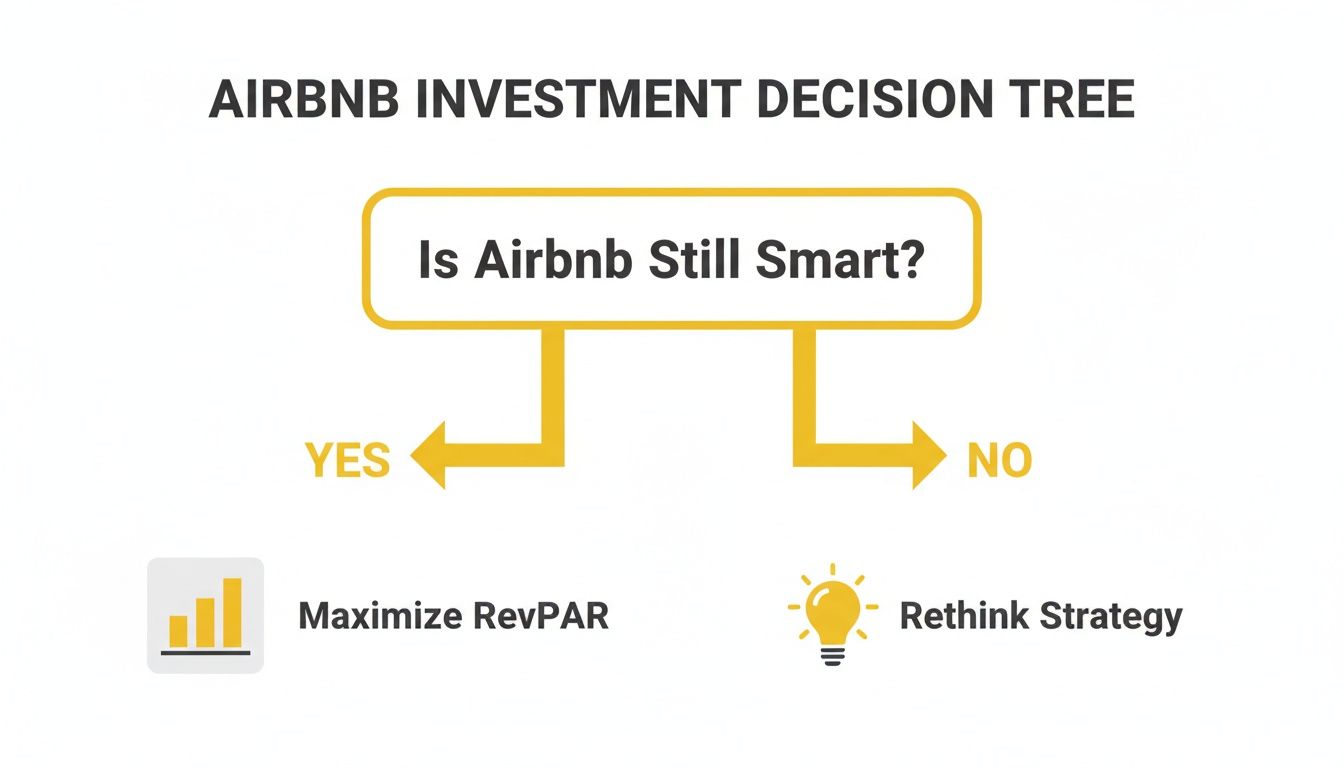
The key takeaway here? Once you decide to move forward, your entire strategy should pivot to maximizing RevPAR. It's the metric that truly matters.
Sizing Up High-Potential Markets
Not all profitable markets are created equal; they cater to different investment goals. Let’s look at two distinct but lucrative U.S. markets to see what I mean. This kind of comparative analysis is also essential when searching for the best cities for traditional rental properties, as the underlying logic is very similar.
| Market Characteristic | Gatlinburg, TN (Steady Cash Flow) | Breckenridge, CO (Premium Seasonal) |
|---|---|---|
| Average Monthly Revenue | $4,439 | $5,328 |
| Average Daily Rate (ADR) | $311 | $537 |
| Primary Appeal | Year-round family tourism (Smoky Mountains) | High-end seasonal skiing and summer hiking |
| Regulatory Environment | Generally favorable with clear guidelines | More restrictive with licensing caps |
| Investor Profile | Prefers consistent, predictable income | Seeks high peak-season returns, higher risk tolerance |
See the difference? Both are fantastic choices, but they demand completely different strategies. Gatlinburg is a workhorse, offering reliable, year-round income. Breckenridge, on the other hand, is a thoroughbred—it delivers incredible revenue during peak seasons but requires a much more hands-on, dynamic pricing strategy to manage the lulls.
Don't Be Afraid to Look Beyond the U.S.
The opportunities for Airbnb investing in 2025 are global. Data from market analysis tools shows hotspots where smart investors are cashing in. While a place like Gatlinburg, USA, brings in an average of $4,439 monthly with low regulatory hurdles, a premium market like Breckenridge commands $5,328 per month with a sky-high ADR of $537.06.
Looking abroad, Bologna, Italy, offers a solid $2,177 monthly. Even emerging markets like Porto Alegre, Brazil, are on the radar for investors who are comfortable with a bit more risk for potentially higher rewards.
Your goal isn't just to find a popular city, but to find a profitable neighborhood within that city. Granular, street-level data is what separates amateur speculation from professional investing.
By building a repeatable process—analyzing core metrics, understanding market types, and using solid data—you can pinpoint your own investment goldmines. When your decisions are grounded in real numbers, you stop hoping for success and start engineering it.
Getting Your Financing and Legal Ducks in a Row
So, you've found a market that looks like a winner. Now for the real work: getting the money and untangling the local red tape. Buying a property for an Airbnb isn't like getting a standard mortgage for your own home. For Airbnb investing in 2025, you need a savvy approach to both financing and regulations.
A classic rookie mistake is walking into your local bank and asking for a simple home loan. Most traditional lenders get nervous when they hear "short-term rental." They see fluctuating income, not a stable, year-long lease, and that often makes them hesitant to lend. This is where you have to get creative and find the right partners.
How to Actually Fund Your Airbnb in 2025
Forget conventional mortgages for a moment. You need to connect with lenders who actually get the short-term rental business. They aren't just looking at your W-2; they want to see a solid business plan.
- DSCR (Debt Service Coverage Ratio) Loans: These are an absolute game-changer for investors. Lenders qualify you based on the property's potential income, not your personal salary. If your projections show the rental revenue will easily cover the mortgage and other costs, you're in a great position to get approved.
- Portfolio Loans: Already have a few investment properties? You can bundle them together to secure financing for a new one. Lenders hold these loans themselves instead of selling them off, which often means more flexibility on the terms.
- Hard Money Loans: Need to move fast on a deal or buy a place that needs a gut renovation? Hard money loans offer quick, short-term cash based on the property’s future value (what they call the ARV, or After Repair Value). The interest rates are higher, no doubt, but they can be the tool that lets you snap up a great opportunity before someone else does.
For a much deeper dive into the pros and cons of these options, our guide on how to finance an investment property breaks it all down.
Making an Irresistible Case to Lenders
When I go to a lender, I don’t just show up with my tax returns. I come prepared with a full-blown business plan, complete with hard data from my market research. It immediately signals that I'm a serious operator, not just someone with a hunch.
Treat your loan application like an investment prospectus. Give them conservative revenue models, show them what competitors are charging (ADR), and provide solid occupancy rate data. This is how you build instant credibility and get them on your side.
Think about the difference in perception:
| What a Traditional Lender Sees | What a Smart Investor Presents |
|---|---|
| Unpredictable, seasonal cash flow | A data-backed revenue forecast, planned for both high and low seasons |
| Risky, unknown guests | A clear guest profile and a professional management strategy |
| Just another home loan application | A complete business plan for a profitable hospitality venture |
Getting your financing is just one piece of the puzzle. The other is legal compliance, and this is where so many would-be hosts get completely derailed. A property that could be a cash cow is worthless if the city won't let you operate it.
Your due diligence here has to be airtight before you even think about making an offer. Start by digging into your target city or county’s official government website. Search for keywords like “short-term rental ordinance,” “lodging tax,” or “STR permit.”
Your Legal Pre-Flight Checklist:
- Zoning Laws: First things first, is the property even in a zone where STRs are allowed?
- Permits & Licenses: Find out exactly what you need to operate. Some cities have a limited number of permits available, sometimes even distributed by lottery.
- Taxes, Taxes, Taxes: Figure out your obligations for collecting and paying lodging and occupancy taxes. This isn't optional, and it often involves filing monthly or quarterly reports.
- HOA Rules: If the property is part of a Homeowners Association, read the bylaws with a fine-tooth comb. One sentence in their rules could kill your entire plan.
Skipping any of these steps is a recipe for disaster, potentially leading to massive fines or a full shutdown. By locking in the right financing and making sure your property is 100% compliant from day one, you’re building a solid, resilient foundation for a successful Airbnb business in 2025.
Designing a Five-Star Guest Experience
So, you’ve found the right property. That's a huge step, but in the world of Airbnb investing, it’s only half the battle. Your operational game plan is what truly separates a decent investment from a cash-flow machine.
A stellar guest experience isn't just about being a good host; it’s a direct lever for pulling in more revenue, earning those coveted 5-star reviews, and building a base of repeat bookers. Let's break down how to turn your property into a high-performance rental that guests can't wait to book.
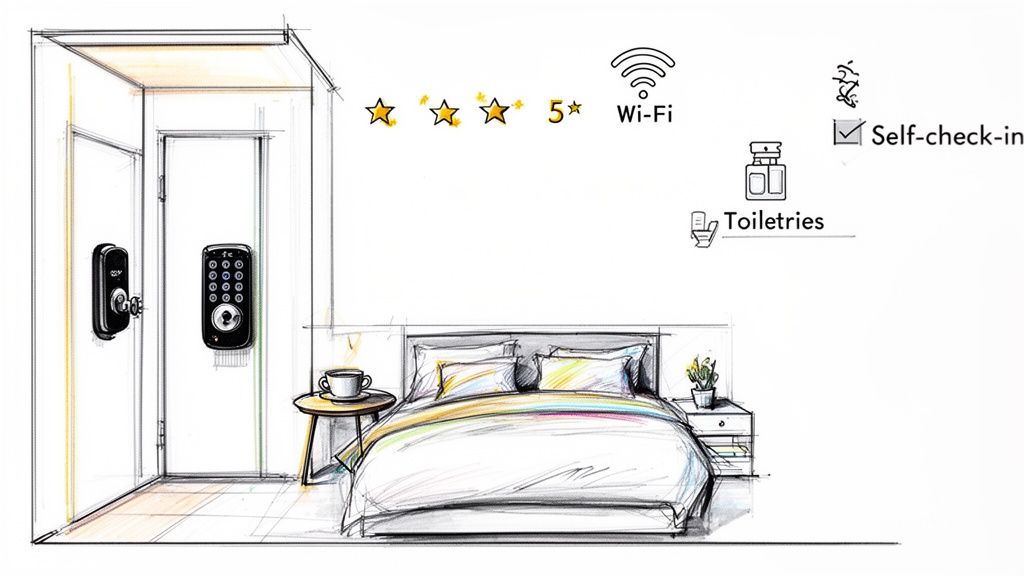
This sketch isn’t just a nice drawing—it’s a visual checklist of what today's guests expect. These aren't luxuries anymore; they're the table stakes for getting noticed and getting booked.
Master Dynamic Pricing
Setting your nightly rate once a season and letting it ride is a classic rookie mistake. You're guaranteed to leave money on the table. The savviest hosts I know all use dynamic pricing, leaning on smart, AI-powered tools to adjust their rates on the fly. These platforms crunch dozens of data points to keep your income optimized.
Here’s a glimpse of what these tools are watching:
- Local Events: That big music festival or industry conference is a goldmine. The software knows and will bump your rates to match the surge in demand.
- Competitor Pricing: It's constantly scanning what similar listings are charging, adjusting your price to keep you competitive without undercutting your value.
- Day of the Week: Of course, weekends are worth more. But by how much? These tools find the perfect premium.
- Booking Lead Time: Your pricing strategy should be different for someone booking six months out versus someone looking for a last-minute stay.
Crafting a Listing That Converts
Think of your Airbnb listing as your digital storefront. It has to do more than just list the number of beds and baths—it needs to sell an experience and build immediate trust.
I see this all the time: hosts using grainy smartphone pictures. Professional photography is a non-negotiable, day-one investment. It's the single most powerful way to make your property pop, and it easily justifies a higher nightly rate.
Your description needs to be just as sharp. Don't just list features; tell a story. Who are you trying to attract? Is it a digital nomad, a family on a summer road trip, or a couple celebrating an anniversary? Speak their language.
For instance, don't just say "Fast Wi-Fi." Instead, try "Blazing-fast fiber optic Wi-Fi and a dedicated workspace—perfect for your work-from-anywhere getaway." This targeted approach helps you maximize rental property income with proven methods because it connects with guests on a personal level.
The Small Details That Command Premium Rates
A five-star experience is built on the little things. It’s the thoughtful details that show you've anticipated a guest's needs before they even have them. These are the things that end up in glowing reviews.
While the U.S. average occupancy rate has settled around 50% as more listings hit the market, RevPAR (Revenue Per Available Room) has jumped by 8.1% year-over-year. What does that tell us? The growth is coming from hosts who know how to command higher rates. They're often catering to the booming business and group travel markets with premium amenities.
Here’s a simple way to think about amenities and how they attract different guests, justifying a higher price.
| Amenity Tier | Examples | Target Guest |
|---|---|---|
| The Essentials | Self check-in (smart lock), fast Wi-Fi, quality linens, coffee maker, basic toiletries. | All Guests |
| The Upgrades | Dedicated workspace, smart TV with streaming, fully-stocked kitchen, blackout curtains. | Business Travelers, Families |
| The Luxuries | Hot tub, high-end espresso machine, welcome basket with local goods, premium sound system. | Discerning Guests, Special Occasions |
By dialing in these operational details—from data-driven pricing to the perfect welcome basket—you create an experience that doesn't just earn top ratings but also builds a resilient and highly profitable Airbnb business.
Crunching The Numbers: Profit, ROI, and Staying Protected
At the end of the day, a great property in a killer market is only a good investment if the numbers work. Guesses and gut feelings won't cut it. You need a solid financial model to analyze any potential deal and see its true potential before you sign on the dotted line.

Let's break down how to build a forecast you can actually trust, starting with the exciting part—the revenue—and then getting real about the expenses that too many new hosts overlook.
Building Your Financial Model
First things first, you need a realistic revenue projection. Don't just pull a number out of thin air. Hop on a tool like AirDNA or Mashvisor to find the Average Daily Rate (ADR) and typical occupancy rates for properties that are nearly identical to the one you're considering, right down to the neighborhood. A city-wide average is far too broad to be useful.
Next, it's time to get brutally honest about your costs. This is where so many aspiring investors stumble, thinking only about the mortgage payment. A profitable Airbnb isn't that simple.
Your costs will generally fall into two buckets:
- Startup Costs: These are the one-off expenses needed to get your doors open. Think furniture, professional photography (a non-negotiable!), smart locks, and any fees for permits or licenses.
- Ongoing Expenses: This is your monthly nut. It covers everything from the mortgage, utilities, and Wi-Fi to cleaning fees, restocking guest supplies, software subscriptions, and, of course, Airbnb's standard 3% host fee.
A Real-World Example Calculation
Let's put this into practice with a simplified model for a two-bedroom city apartment. This is the kind of breakdown you should be doing for every single property you analyze. You can build this in a simple spreadsheet or use a dedicated rental property ROI calculator to play with the numbers.
Here’s a look at how the financials might shake out for a hypothetical property.
| Sample Airbnb ROI Calculation (City Center Apartment) |
| :— | :— | :— |
| Financial Metric | Calculation/Value | Notes |
| Projected Annual Revenue | $250 ADR x 182 nights (50% Occ.) = $45,500 | Based on local comps for similar properties. |
| Total Startup Costs | $15,000 | Includes furniture, decor, photos, and initial supplies. |
| Annual Operating Expenses | $28,800 | Mortgage ($24k), utilities ($2.4k), cleaning & supplies ($2.4k). |
| Net Operating Income (NOI) | $45,500 Revenue – $28,800 Expenses = $16,700 | This is your profit before taxes. |
| Cash-on-Cash Return | ($16,700 NOI / $60,000 Down Payment) = 27.8% | Measures the return on your actual cash invested. |
This table gives you a clear picture of the property's financial health.
The Cash-on-Cash return is your north star. It tells you exactly how hard your invested cash is working for you, which is the perfect metric for comparing one deal against another.
Essential Risk Mitigation Strategies
Making money is one thing; keeping it is another. Unexpected events can wipe out your profits in a heartbeat if you’re not prepared. A resilient Airbnb investing 2025 plan absolutely must include a defense strategy.
First, get the right insurance. Your standard homeowner's policy won't cover you for business activities. You need a dedicated short-term rental policy that covers liability, property damage, and—critically—loss of income. While platforms provide things like AirCover, think of that as a backup, not your primary line of defense.
Next, build a maintenance fund. I always tell new hosts to earmark 5-10% of their monthly revenue specifically for repairs. When the AC unit dies in the middle of July or a pipe bursts, you’ll be glad you have a cash reserve instead of scrambling to cover a massive bill.
Finally, have a "Plan B." What will you do if local regulations suddenly change or the market takes a nosedive? Your contingency plan might involve pivoting to a 30-day+ rental model. Knowing you have options ensures your investment can weather whatever comes its way.
Frequently Asked Questions About Airbnb Investing
1. Is Airbnb still a profitable investment in 2025?
Yes, but the strategy has shifted from maximizing occupancy to maximizing Revenue Per Available Room (RevPAR). Success now hinges on data-driven pricing, targeting specific traveler niches (like business or group travel), and offering premium amenities that justify higher nightly rates. The "set it and forget it" approach no longer works in a competitive market.
2. How much capital do I need to start an Airbnb?
This varies significantly by market. For a lower-cost area, you might need a 20% down payment (e.g., $40,000 on a $200,000 property) plus $15,000-$20,000 for furniture, professional photos, and initial supplies. In a high-demand vacation market, these figures could be three to five times higher.
3. What are the most critical tools for managing an Airbnb remotely?
A solid tech stack is non-negotiable for remote management. The essentials include:
- Property Management System (PMS): Tools like Guesty or Hostfully automate bookings, messaging, and cleaner coordination.
- Dynamic Pricing Software: Platforms like PriceLabs or Wheelhouse use algorithms to optimize your rates daily.
- Smart Home Devices: A smart lock for keyless entry is a must-have. Noise monitors and smart thermostats can prevent parties and save on utility costs.
Start by visiting your target city or county’s official government website and searching for "short-term rental ordinance" or "STR permit." Consult with a local real estate agent who specializes in investment properties. For ultimate peace of mind, have a local attorney review the regulations to ensure your property is fully compliant with zoning, licensing, and tax requirements before you buy.
5. Should I manage the property myself or hire a professional manager?
This is a time vs. money decision. Self-management means you keep 100% of the profits and have full control, but it is a significant time commitment. Hiring a property manager makes the investment truly passive but will cost 20-30% of your gross rental income. If you live far from the property or value your time highly, a manager is often the right choice.
6. What kind of insurance is required for an Airbnb?
Your standard homeowner's insurance policy will not cover commercial activity. You need a dedicated short-term rental insurance policy that includes liability coverage (if a guest is injured), property damage protection, and loss of income coverage in case your property becomes unrentable due to a covered event like a fire.
7. What are the biggest mistakes new Airbnb investors make?
The most common rookie errors are underestimating both startup and ongoing operational costs, failing to perform due diligence on local regulations, using poor-quality photos for their listing, setting prices manually instead of using dynamic pricing tools, and not having a contingency fund for unexpected maintenance.
8. What's a real-life example of a profitable Airbnb investment?
Consider an investor who purchased a 3-bedroom cabin near Gatlinburg, TN. By targeting the year-round family travel market, they furnished it with bunk beds, a hot tub, and a game room. Using dynamic pricing, they achieve an average daily rate (ADR) of $350. Even with a 65% occupancy rate, their annual revenue exceeds $82,000. After mortgage, taxes, management fees, and expenses, their net operating income allows for a cash-on-cash return of over 20%.
9. How important are professional photos and a good listing description?
They are absolutely critical. In a crowded market, professional photos are the single most important factor in making your listing stand out and command a higher price. A well-crafted description that tells a story and appeals to your target guest (e.g., "the perfect remote work retreat" or "your family's adventure basecamp") will convert views into bookings far more effectively than a simple list of features.
10. How are Airbnb earnings taxed?
Your rental income is taxable, but you can deduct a wide range of business expenses, including mortgage interest, property taxes, insurance, cleaning fees, supplies, utilities, and platform fees. You are also typically required to collect and remit local and state occupancy taxes. It is highly recommended to work with a CPA who specializes in real estate to ensure compliance and maximize your deductions.
This article is for educational purposes only and is not financial or investment advice. Consult a professional before making financial decisions.
At Top Wealth Guide, we're dedicated to giving you the insights and strategies needed to build lasting wealth through smart investments. To continue learning and access more exclusive guides, visit us at https://topwealthguide.com.
