

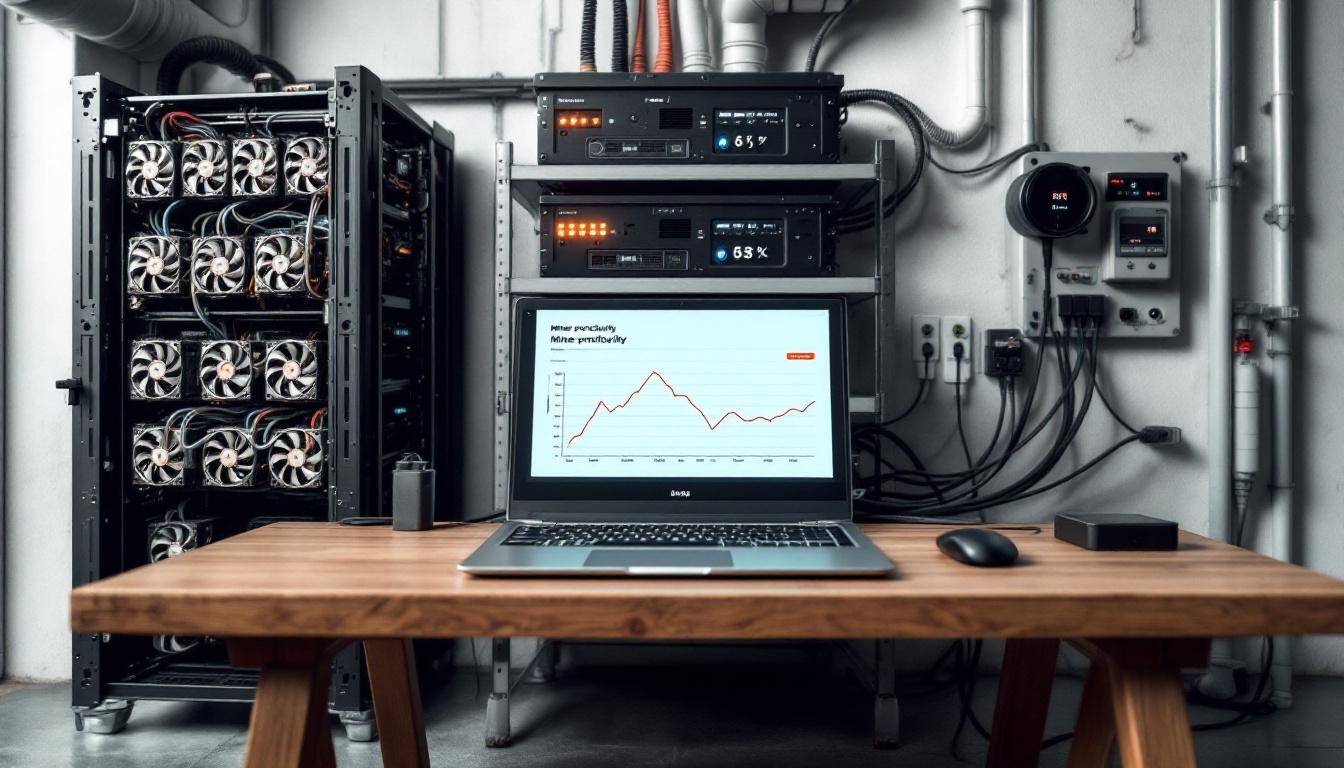
Cryptocurrency mining is profitable only when realized revenue exceeds electricity, fees, operating costs and the cost of the equipment. There is no universal profitable electricity rate or machine count. Model the specific hardware, coin, network conditions and operating arrangement using dated inputs.
The example below illustrates Bitcoin-style proof-of-work mining economics. It does not apply unchanged to every cryptocurrency, and it is not a quote for current hardware or mining revenue.
In This Guide
Separate mining mechanics from the investment case
The Bitcoin developer guide distinguishes solo mining from pooled mining. Pooling can reduce the variability of receipts by sharing work and rewards, but the pool’s payout terms, fees and operational risks still matter. More regular payouts do not guarantee positive net income.
Expected coin production depends on effective hashing work, network competition, reward conditions and uptime. Revenue in money also depends on the price at which coins are valued or sold. Keep estimated production separate from actual receipts and identify which assumptions change over time.
Build a dated input sheet
| Input | Evidence to obtain |
|---|---|
| Hardware performance | Model-specific hash rate, wall-power measurements and operating conditions |
| Electricity | Actual tariff, additional charges and any contractual limits |
| Mining revenue | Dated production estimate, coin-price assumption and payout method |
| Pool or host | Fees, payment conditions, downtime policy and withdrawal terms |
| Other operations | Cooling, repair, networking, space and applicable insurance |
| Equipment capital | Delivered purchase cost, expected useful life and uncertain resale value |
| Compliance | Applicable local operating, utility and tax requirements |
An advertised device specification is not a complete operating budget. Measure electricity for the intended setup, including auxiliary systems where relevant. A tariff that excludes demand or other charges may understate the bill.
A hypothetical daily operating model
Assume a device draws 3 kW continuously for 24 hours, producing estimated gross revenue of $10 daily. Assume a 2% revenue-based pool fee. Ignore auxiliary power and other cash costs for this first simplified calculation.
| Item | At $0.10 per kWh | At $0.20 per kWh |
|---|---|---|
| Electricity use | 72 kWh | 72 kWh |
| Electricity cost | $7.20 | $14.40 |
| Gross revenue | $10.00 | $10.00 |
| Pool fee | $0.20 | $0.20 |
| Cash before other costs | $2.60 | Minus $4.60 |
The $2.60 operating surplus is not full economic profit. Suppose delivered equipment costs $3,000 and an invented resale value of $500 is assumed after 730 days. A straight-line economic capital allowance is ($3,000 minus $500) divided by 730, about $3.42 daily. Subtracting it from $2.60 leaves roughly minus $0.82 before other costs. This allowance is not a statement of tax depreciation rules.
Calculate break-even from the actual model
Before the equipment allowance and other costs, the example’s maximum electricity price is ($10 minus $0.20) divided by 72, about $0.1361 per kWh. After the unrounded equipment allowance, it falls to about $0.0885 per kWh. Different revenue, power consumption, fees and capital assumptions produce different thresholds.
If gross daily revenue falls 20% to $8, the 2% fee becomes $0.16. At the same $7.20 electricity cost, only $0.64 remains before equipment and other costs. Do not calculate a fixed payback horizon while silently assuming the original daily revenue never changes.
Stress uptime, resale and contract terms
Test lower production, lower coin prices, higher tariffs, repair downtime and a lower resale value. Examine whether a hosted arrangement charges fixed fees even while equipment is offline and who bears repair or shipping costs. Confirm ownership of equipment and the practical process for retrieving it.
Pooling and hosting are different decisions. A pool distributes mining proceeds under its method; a host operates equipment under a separate agreement. Neither removes exposure to the coin, network economics or counterparty performance.
Compare the project with the goal it serves
Buying a crypto asset, operating mining hardware and holding a mining company’s shares are different exposures. Compare capital at risk, work, liquidity and after-cost outcomes. The crypto strategy guide helps separate custody and exposure from an operating-business plan.
Do not describe staking as interchangeable with mining or as a guaranteed easier profit. Each process has its own asset, rules and risks. If the purpose is recurring household cash, compare the uncertainty with the income-stream framework.
A monthly operating review
- Reconcile actual coin receipts and realized sales with the estimate.
- Check measured energy and the full utility or host bill.
- Record fees, repairs, downtime and equipment commitments.
- Update the adverse case and break-even calculation.
- Decide whether continued operation, repair or exit is supported by forward economics.
Track units and money separately, with dated prices and cash-flow records. Use the return-measurement guide when evaluating a project with purchases, operating receipts and a later equipment sale.
Source
Reviewed October 12, 2026. All revenue, electricity, fee and hardware figures are hypothetical. This is an operating-model framework, not a current profitability forecast or tax calculation.
