


So, you’re thinking about getting into real estate. Good. Forget the idea that it’s some exclusive club for the ultra-wealthy. At its heart, real estate investing is surprisingly straightforward: you buy property to either collect rent or sell it later for a profit. That’s it. It’s one of the most reliable ways people have built real wealth for generations, and it’s more accessible than you’ve been led to believe.
In This Guide
- 1 Your Simple Start In Real Estate Investing
- 2 Exploring Four Main Types Of Real Estate Investments
- 3 How To Know If You Have Found A Good Deal
- 4 Financing Your First Real Estate Investment
- 5 Navigating The Risks And Avoiding Common Pitfalls
- 6 Your Action Plan to Get Started
- 7 Answering Your Top 10 Real Estate Investing Questions
- 7.1 1. How much money do I actually need to start?
- 7.2 2. Is real estate a better investment than stocks?
- 7.3 3. What's the easiest way for a total beginner to start?
- 7.4 4. Can I invest in real estate with bad credit?
- 7.5 5. How do I find good tenants for my rental property?
- 7.6 6. What is a "good" return on a real estate investment?
- 7.7 7. What are the main tax benefits of owning rental property?
- 7.8 8. Should I hire a property manager?
- 7.9 9. What's the single biggest mistake new investors make?
- 7.10 10. How do I know if a location is a good place to invest?
Your Simple Start In Real Estate Investing
If the thought of buying an investment property feels like trying to solve a Rubik's Cube in the dark, you're in the right place. This is your roadmap.
Think of it this way: investing in real estate isn't like gambling on the stock market's daily whims. It’s much more like owning a small, predictable business. The property is your asset, and the monthly rent checks are your revenue. The goal is simple—make sure more money comes in than goes out. When you get that right, you’ve created positive cash flow.
Understanding The Basics
Before we go any further, let's nail down the two fundamental ways you make money in real estate. It all boils down to these two concepts:
- Cash Flow: This is the profit you pocket each month after all the bills are paid. We’re talking about what's left from the rent once you've covered the mortgage, property taxes, insurance, and set aside some cash for repairs. Positive cash flow is like getting an extra paycheck every single month.
- Appreciation: This is the slow, steady increase in your property's value over time. While cash flow pays your bills today, appreciation builds your long-term wealth. It’s the nest egg that grows in the background, which you can cash in on when you eventually sell.
The smartest investors don't choose one or the other—they aim for both. A classic move for beginners is "house hacking." You could buy a duplex, live in one half, and rent out the other. The rent from your tenant helps pay down your mortgage, drastically cutting your own living expenses while the entire property quietly grows in value.
If that sounds interesting, our detailed guide on how to buy your first rental property breaks down every step.
Why Now Is A Good Time To Learn
People are always trying to "time the market," but seasoned investors know that's a fool's errand. Real estate moves in cycles. Sometimes it's a seller's market, and other times it's a buyer's market. The real secret isn't predicting the perfect moment to jump in; it's learning how to find a good deal that works financially in any market.
Right now, we're seeing a lot of movement globally. For example, commercial real estate deals in Europe recently jumped to €188.8 billion, a 13.7% increase in just one year. We're seeing similar trends in the US (up 11.3%) and Asia (up 13.4%), according to a global real estate outlook from Aberdeen.
What does that mean for you? It signals renewed confidence and a more active market, which creates fresh opportunities for new investors to find their footing. This guide is designed to give you the fundamental knowledge to spot those opportunities and build a strategy that works for you.
Exploring Four Main Types Of Real Estate Investments
Deciding on your first real estate investment is a bit like choosing your first car. Are you looking for a dependable sedan for the long haul, or a classic sports car you can fix up and sell for a quick profit? Investing in property isn’t just one path; it’s a whole network of strategies, each designed for different goals, budgets, and levels of hands-on involvement.
For newcomers, the world of real estate can be boiled down to four main entry points. Think of them as four different doors, each leading to a unique kind of opportunity with its own set of rules and rewards. Getting a handle on these foundational options is the first real step toward turning your financial goals into a concrete plan.
Rental Properties For Steady Income
This is the classic, time-tested approach to real estate investing: buying a property and renting it out to tenants. It’s the ultimate “buy and hold” strategy. You might purchase a single-family home, a condo, or a small apartment building with the primary goal of generating consistent monthly cash flow.
This path is perfect for investors who prioritize long-term stability and are ready to embrace the role of a landlord. While it definitely requires more hands-on work—from screening tenants to fixing the inevitable leaky faucet—it pays off in two ways: steady monthly income and the potential for long-term appreciation as the property’s value grows over time.
House Flipping For Active Profits
Got a talent for renovation and an eye for what a property could be? House flipping might be right up your alley. The game plan is simple, but the execution is key: buy a rundown or undervalued property, pour in some sweat equity and capital to increase its market value, and then sell it for a profit. This usually happens within a few months to a year.
Flipping is a much more active, short-term play compared to holding rentals. Success hinges on your ability to create an accurate renovation budget, truly understand local market values, and keep construction on schedule. While it offers the thrill of a potentially large, lump-sum payout, it also carries higher risks if your costs spiral or the market takes an unexpected turn.
The flowchart below can help you visualize how your primary goal—income or profit—points you toward one path or the other.
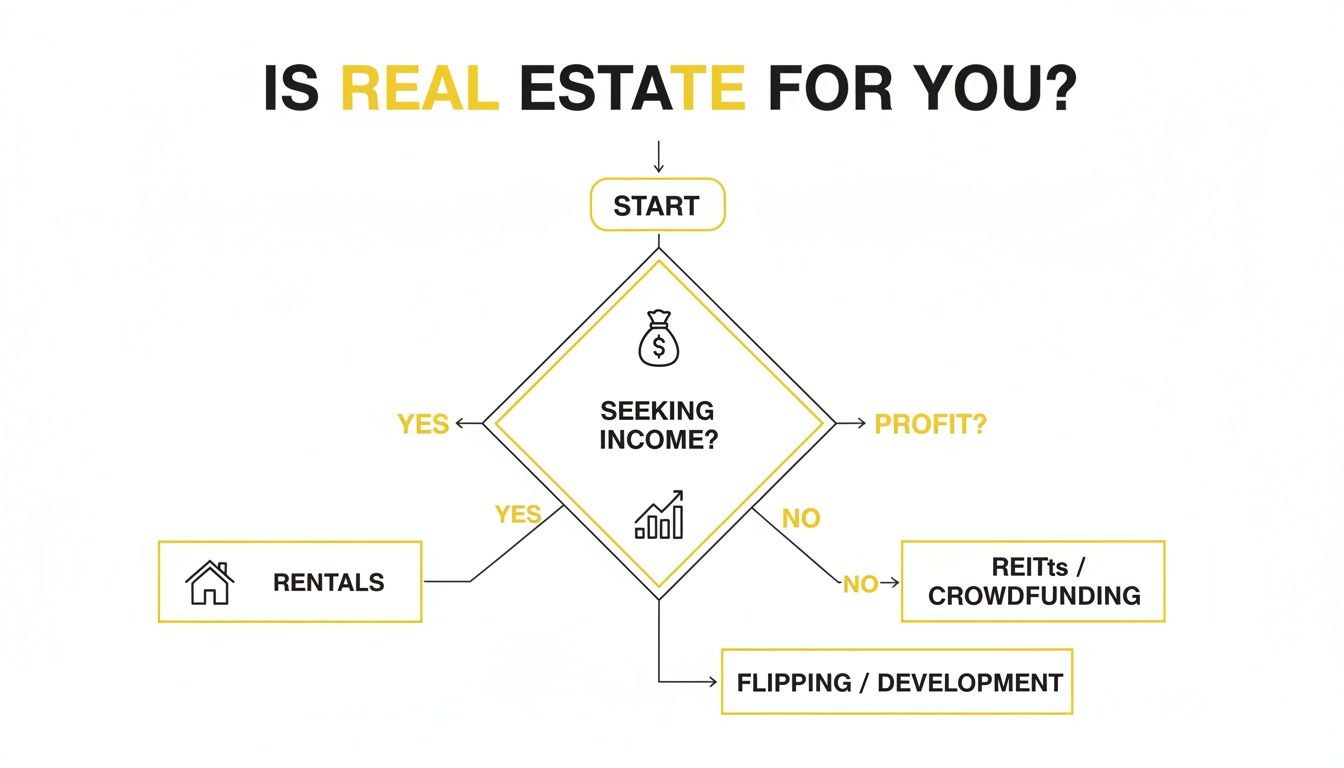
As you can see, the right strategy for you often comes down to answering one simple question about your end goal.
REITs The Stock Market Of Real Estate
What if you want a piece of the real estate pie without the late-night calls about a broken toilet? That’s where Real Estate Investment Trusts (REITs) come in. In simple terms, REITs are companies that own, operate, or finance income-producing properties, from massive apartment complexes and shopping malls to office towers.
You can buy and sell shares of publicly traded REITs on stock exchanges, just like you would with shares of a tech company. This makes them an incredibly liquid and accessible way to get into the market with very little startup cash. You get instant diversification across a huge portfolio of properties and earn passive income through dividends, all without ever having to manage a property yourself. If this hands-off approach sounds appealing, you can learn more about REITs in our complete guide.
Real Estate Syndications A Team Approach
Ever dreamed of owning a huge apartment building but lacked the millions to do it? A real estate syndication is your answer. It’s essentially a group investment where a number of investors pool their capital to purchase a much larger asset than any one of them could afford alone.
Here’s how it works: an experienced professional, called the "sponsor" or "general partner," finds the deal, manages the entire process, and handles the day-to-day operations. You, as an investor or "limited partner," contribute capital in exchange for a slice of the profits. It's a fantastic way to passively invest in high-value, institutional-quality properties that are normally out of reach for the average person.
To bring it all together, here’s a quick comparison of these four strategies to help you see where you might fit in.
Comparing Real Estate Investment Strategies for Beginners
This table compares the four main real estate investment types on key factors like initial capital, management effort, and risk level to help you choose the right path.
| Investment Type | Typical Capital Needed | Effort Required | Risk Level | Best For |
|---|---|---|---|---|
| Rental Properties | Moderate to High (down payment, closing costs) | High (landlord duties) | Moderate | Long-term wealth builders who want direct ownership and control. |
| House Flipping | Moderate to High (purchase + renovation costs) | Very High (project management) | High | Hands-on individuals seeking short-term, lump-sum profits. |
| REITs | Low (cost of a single share) | Low (passive, like stocks) | Low to Moderate | Beginners who want a low-cost, liquid, and hands-off investment. |
| Syndications | Moderate (minimums often start at $25k) | Low (passive) | Moderate to High | Investors who want passive access to larger, institutional-grade deals. |
Each of these paths offers a distinct way to build wealth through property. By thinking honestly about the capital you have, the effort you’re willing to put in, and the level of risk you’re comfortable with, you can confidently start down the road that’s right for you.
How To Know If You Have Found A Good Deal
Anyone can find a house for sale. The real skill—the one that separates successful investors from frustrated ones—is learning how to spot a genuinely good deal.
This is where you have to take off the "homeowner" hat and put on your "investor" hat. It’s not about falling in love with the kitchen countertops or the backyard. It's about a simple, repeatable process of digging into the numbers to see if a property can actually make you money.

Let's walk through the exact steps to analyze a potential investment. We'll leave the guesswork behind and focus on the math that tells you whether you've found a money-maker or a money pit.
Starting With Quick And Simple Rules
Before you ever open a spreadsheet, experienced investors use a few mental shortcuts to quickly screen properties. Think of it as a first-pass filter. The most common one you'll hear about is the 1% Rule.
It's simple: does the property's gross monthly rent equal at least 1% of the purchase price?
So, if you're looking at a $200,000 house, you'd want to see it renting for at least $2,000 a month. This little rule of thumb is a fantastic way to instantly gauge if a deal has potential.
This isn't a law written in stone, but it’s an incredibly useful starting point. If a $300,000 property only brings in $1,800 a month (0.6%), you already know that making the numbers work will be an uphill battle. It helps you toss out the duds and focus your energy on deals that have a real shot.
Calculating Your True Cash Flow
Okay, so a property passed the 1% Rule. Now it's time to get serious. The goal here is to find the Net Operating Income (NOI), which leads you to the holy grail: monthly cash flow. This is the actual profit you have left after every single expense is paid—not just the mortgage.
New investors almost always underestimate their expenses. To do it right, you have to account for everything:
- PITI (Principal, Interest, Taxes, and Insurance): This is your basic monthly mortgage payment.
- Vacancy: No rental is occupied 100% of the time. People move out. It’s smart to budget 5-10% of the monthly rent for those inevitable empty months.
- Repairs & Maintenance: Toilets leak, garbage disposals break, and walls need patching. Plan on another 5-10% of rent going toward keeping the place in good shape.
- Capital Expenditures (CapEx): This is the big one people forget. A roof only lasts 25 years. An HVAC system has a 15-year lifespan. You must set money aside for these huge, predictable future expenses. Budget another 5-10%.
- Property Management: Thinking of managing it yourself? Great, but your time isn't free. Pay yourself! Budget 8-12% of the rent, whether you're hiring a pro or doing it yourself.
Once you subtract all of these expenses from your monthly rent, you’re left with your true cash flow. If that number is positive, the property is officially paying you to own it.
Putting It All Together: A Real-Life Example
Let's run the numbers on a hypothetical single-family rental to see how this works in the real world.
| Metric | Amount | Description |
|---|---|---|
| Purchase Price | $250,000 | The all-in cost to buy the property. |
| Down Payment (20%) | $50,000 | Your cash out of pocket. |
| Gross Monthly Rent | $2,500 | Perfect! This meets the 1% Rule. |
| Monthly Mortgage (PITI) | $1,500 | Principal, interest, taxes, and insurance. |
| Vacancy (8%) | $200 | Saving for when it's empty between tenants. |
| Repairs & Maint. (8%) | $200 | Budgeting for routine fixes. |
| CapEx (8%) | $200 | A "sinking fund" for big-ticket replacements. |
| Property Management (10%) | $250 | The cost to have a pro manage it (or pay yourself). |
Time for some quick math:
- Total Monthly Expenses: $1,500 (PITI) + $200 (Vacancy) + $200 (Repairs) + $200 (CapEx) + $250 (Mgmt) = $2,350
- Monthly Cash Flow: $2,500 (Rent) – $2,350 (Expenses) = $150
- Annual Cash Flow: $150 x 12 = $1,800
Success! This property puts money back in your pocket every single month.
Key Takeaway: A good deal isn't about how much rent you collect. It's about how much profit you keep after accounting for all the real-world expenses, both now and in the future.
Another powerful metric investors love is the Cash-on-Cash Return. This tells you how hard your actual invested money is working for you. In this case, you put $50,000 down to earn $1,800 per year.
Cash-on-Cash Return = (Annual Cash Flow / Total Cash Invested) = ($1,800 / $50,000) = 3.6%.
While 3.6% might seem modest, remember that this doesn't even count the wealth you're building through appreciation and your tenant paying down your loan.
As you get more comfortable, you can dive into more advanced metrics. To really sharpen your analysis skills, check out our guide on Cap Rate. Ultimately, what makes a "good deal" is personal—it's the one that meets your financial goals.
Financing Your First Real Estate Investment
One of the biggest hurdles for new investors is the idea that you need a mountain of cash to even get in the game. It’s a common myth, but it’s just that—a myth. While having deep pockets certainly helps, the real key to building a portfolio is understanding the power of leverage.
Leverage is just a fancy word for using other people's money (usually the bank's) to buy an asset. Think of it like using a long pry bar to move a giant boulder. Your down payment is the small amount of force you apply, but the loan is the pry bar that multiplies your strength, allowing you to control a valuable property you couldn't have bought on your own. This is how smart investors amplify their returns, but it’s a tool that must be respected; too much leverage can amplify your risk, too.

Unlocking The Lender's Door
So, how do you convince a lender to give you that leverage? Before they hand over a hefty check, they need to feel confident you’ll pay it back. They cut through the noise and focus on two crucial numbers:
- Debt-to-Income Ratio (DTI): This is a straightforward look at what you make versus what you owe. Lenders calculate the percentage of your gross monthly income that goes toward all your debt payments (car loans, student loans, credit cards). They want to see plenty of breathing room for a new mortgage, generally looking for a DTI below 43%.
- Loan-to-Value Ratio (LTV): This ratio measures the loan amount against the property's appraised value. If you’re buying a $200,000 property with a $40,000 down payment (20%), your loan is $160,000. That gives you an LTV of 80% ($160,000 ÷ $200,000). The lower your LTV, the more "skin in the game" you have, which makes lenders feel much more secure.
Getting these two numbers in line is your first step to getting a "yes" on most traditional loans.
Exploring Your Funding Options
Not all loans are built the same, and your options go way beyond what you'd get for a standard family home. First-time investors have a few different paths to consider, each with its own pros and cons. The right choice can be the difference between a profitable deal and a non-starter.
If you’re ready for a deep dive on this topic, our guide on how to finance an investment property in our comprehensive article has you covered.
For now, here’s a quick breakdown of three popular options for new investors.
| Financing Option | Best For | Key Advantage | Major Consideration |
|---|---|---|---|
| FHA Loan | House-hackers and owner-occupants. | The down payment is incredibly low, often just 3.5%. | You must live in the property as your primary residence for at least a year (but you can buy a multi-unit!). |
| Seller Financing | Investors who can't get a traditional loan. | The seller basically becomes the bank, which can mean more flexible terms. | You’ll likely pay a higher interest rate than a bank would offer. |
| Partnerships | Investors who find a great deal but are short on cash. | You can pool your money and skills with others to make a purchase happen. | Demands a rock-solid legal agreement that spells out everyone’s roles, responsibilities, and profit splits. |
Let's see how this works in the real world.
A Real Life Example Of Creative Financing
Meet Sarah, a young professional eager to start investing but with only $15,000 in savings. In her market, that wasn't nearly enough for the standard 20% down payment on a decent rental property.
Instead of giving up, she got creative. She found a duplex for sale at $350,000. Because it was a multi-unit property, she could qualify for an FHA loan, which only required 3.5% down—a total of $12,250. The only string attached? She had to live in one of the units for at least one year.
She jumped on it. By "house hacking" the duplex, the rent from her tenant in the other unit covered most of her mortgage payment. Sarah was living almost rent-free while building equity in an appreciating asset. That one smart financing move, without needing a huge pile of cash, was the launchpad for her entire real estate career.
Let's be real: every investment has its risks, and anyone who tells you real estate is a sure thing is selling something. The goal isn't to find a "risk-free" deal—that unicorn doesn't exist. The real skill is learning to spot trouble before it starts and having a plan to deal with it.
Think of it like this: your first property is a bit like sailing a ship. You can't just point it at the horizon and hope for the best. You need to know where the rocks are hidden. The investors who last in this game aren't necessarily the biggest risk-takers; they're the ones who are best prepared.
Overlooking The Real Costs
One of the most common rookie mistakes is getting tunnel vision on the mortgage payment. You run the numbers, it looks great, and you pull the trigger. But the mortgage is just the beginning. The "hidden" costs are what can sink your cash flow and turn a great deal into a money pit.
To protect yourself, you need a painfully realistic budget. Here’s what to include:
- Maintenance and Repairs: Things break. It's a guarantee. Set aside 5-10% of the monthly rent to handle everything from a clogged drain to a broken dishwasher.
- Capital Expenditures (CapEx): This is your savings fund for the big stuff—the roof, the HVAC, the water heater. These are the expensive items with a limited lifespan. Ignoring CapEx is like ignoring a ticking clock.
- Vacancy: Your property will sit empty at some point. It's just a fact of life. Budgeting for a 5-8% vacancy rate means you won't be in a panic when a tenant moves out.
A Real-Life Example: An investor buys their first rental and only accounts for the mortgage. Six months in, the AC unit dies. That’s a $5,000 bill they never saw coming. Without a repair fund, it goes on a high-interest credit card, and just like that, years of potential profit are gone. A proper budget would have seen that coming.
The Dangers Of Over-Leveraging
Using other people's money to buy property is how wealth is built in real estate. But leverage is a double-edged sword. If you're over-leveraged, you've borrowed so much that you have almost no equity and absolutely no wiggle room.
A small dip in rent or one unexpected repair can instantly throw you into negative cash flow. Suddenly, you're paying out of your own pocket just to keep the property afloat. That's why having a contingency fund of 3-6 months' worth of total expenses isn't just a suggestion; it's a necessity. It’s your financial shock absorber.
Location, Location, Volatility
Not all markets are created equal. It can be tempting to jump into a "hot" market where prices are skyrocketing, but that's a high-stakes game. For new investors, stability beats hype every single time. A steady, moderate-growth market is a much safer bet.
This is a huge part of your initial homework, and our real estate due diligence checklist is designed to help you break down a location's true potential.
Market reports consistently prove this point. For instance, the UBS Global Real Estate Bubble Index has flagged cities like Miami and Tokyo as having elevated risks. Meanwhile, places like Madrid or Munich offer a more predictable path. The lesson here is simple: picking the right location is your single best defense against market swings.
By getting ahead of these common pitfalls—underestimating your costs, borrowing too much, and picking a volatile location—you can build a solid foundation for your real estate portfolio right from the start.
Your Action Plan to Get Started
Alright, we’ve covered a lot of ground. But all the knowledge in the world won't put a dollar in your pocket until you take action. This is where the rubber meets the road.
Let’s break down the paralysis that so often stops new investors in their tracks. Think of this as your "first steps" checklist. The goal isn't to buy a property tomorrow; it's to build a solid foundation so you're ready to pounce when the right deal comes along.
Step 1: Get Your Financial House in Order
Before you can even think about managing an investment property, you have to be the master of your own finances. Lenders are going to put your financial health under a microscope, so it’s best to get out in front of it now.
Here’s what to focus on:
- Check Your Credit Score: Pull your free credit report and see where you stand. Anything above a 740 is generally considered excellent and will open the door to the most favorable interest rates.
- Figure Out Your DTI: Your Debt-to-Income ratio is a huge deal for lenders. Just add up all your monthly debt payments (car, student loans, credit cards) and divide that by your gross monthly income. Ideally, you want this number to be under 43%.
- Build Your "Go" Fund: Start a separate, dedicated savings account just for your down payment and reserves. Set up automatic transfers every week or payday. Even small, consistent contributions build serious momentum over time.
Step 2: Define Your "Why" and Your "What"
Saying "I want to invest in real estate" is too vague. Vague goals get vague results. You need to get crystal clear on what you're actually trying to accomplish.
Sit down and write it out. Is your goal to generate $500 a month in cash flow within two years? Or maybe it's to complete your first successful house flip in the next 18 months? This "why" is the fuel that will keep you pushing forward when things inevitably get tough.
Investor Insight: Don't pressure yourself to hit a home run on your first deal. The real goal of that first property is education. You're learning the process, building your confidence, and creating a launchpad for every deal that follows.
Step 3: Become an Expert on Your Own Backyard
Forget about the national market trends for now. The only market that matters when you're starting is the one you can drive through on a Saturday morning.
Start spending time in the neighborhoods you're considering. What's the vibe? Are the homes well-kept? How close are the good schools, the parks, the grocery stores? Count how many "For Rent" signs you see. This kind of on-the-ground recon is priceless, and it costs you nothing but a bit of gas and time.
Answering Your Top 10 Real Estate Investing Questions
Jumping into real estate investing naturally comes with a long list of questions. To help you get some clarity, here are the straight-up answers to the 10 most common questions from aspiring investors.
1. How much money do I actually need to start?
You don't always need a massive 20% down payment. If you're willing to live in the property ("house hacking"), an FHA loan for a multi-family home can drop that requirement to just 3.5% down. Creative strategies like seller financing or partnerships can also lower the barrier. The key is having enough for the down payment, closing costs, plus a separate cash reserve of 3-6 months of total property expenses for emergencies.
2. Is real estate a better investment than stocks?
They're different tools for different jobs, and smart investors often use both. Real estate is a tangible asset that offers unique tax benefits and the power of leverage. Stocks offer unparalleled liquidity and easy diversification with low entry costs. Real estate is generally less volatile day-to-day but requires more hands-on effort. Many seasoned investors build a portfolio that uses the strengths of both.
3. What's the easiest way for a total beginner to start?
It boils down to how hands-on you want to be. For a truly passive approach, buying shares in a Real Estate Investment Trust (REIT) is the winner. It's as simple as buying a stock. For those wanting to own property, "house hacking" a duplex or triplex is a brilliant strategy. You live in one unit while tenants in the others pay down your mortgage, drastically cutting your living expenses.
4. Can I invest in real estate with bad credit?
It’s harder, but not impossible. A low credit score will likely take traditional bank loans off the table. However, you can pursue alternative routes like finding a seller willing to offer seller financing, partnering with someone who has strong credit, or using hard money lenders. Be aware these options almost always come with much higher interest rates. The best long-term strategy is to actively work on improving your credit score before seeking financing.
5. How do I find good tenants for my rental property?
A rock-solid, consistent screening process is non-negotiable. A bad tenant can wipe out years of profit. Your screening checklist must include: a credit check, a criminal background check, income verification (a common standard is gross monthly income of at least 3x the rent), and calling their previous landlord references to ask about payment history and property care.
6. What is a "good" return on a real estate investment?
While "good" is subjective, many active investors target a cash-on-cash return of 8-12% or higher. For a rental property, the most fundamental sign of a good deal is positive cash flow. After paying the mortgage, taxes, insurance, and setting aside money for future repairs and vacancies, is there still money left in your bank account each month? If yes, you're on the right track.
7. What are the main tax benefits of owning rental property?
The tax advantages are a huge draw. As a landlord, you can deduct a wide range of operating expenses, including mortgage interest, property taxes, insurance, and repair costs. The biggest advantage is depreciation. The IRS allows you to deduct a portion of your property's value each year as a "paper loss," which can significantly reduce or even eliminate the income tax you owe on your rental income.
8. Should I hire a property manager?
This is a time vs. money decision. A good property manager typically charges 8-12% of the collected monthly rent. In return, they handle everything: marketing, tenant screening, rent collection, late-night repair calls, and even evictions. If you live out of state, have a demanding day job, or want your investment to be as passive as possible, that fee is often worth its weight in gold.
9. What's the single biggest mistake new investors make?
Underestimating expenses. Newcomers often get tunnel vision on the mortgage payment and forget about the "profit killers" like vacancies (your property won't be rented 100% of the time), routine maintenance, and large capital expenditures (a new roof in 10 years, a dead HVAC system). Failing to budget for these from day one is the fastest way to turn a promising investment into a financial drain.
10. How do I know if a location is a good place to invest?
You're buying into a neighborhood, not just a building. Look for signs of a healthy, growing economy: steady job growth, increasing population, low crime rates, and well-regarded schools. Proximity to amenities like parks, grocery stores, and good transportation also adds value. Before making an offer, drive the neighborhood at different times of the day and week to get a true feel for the area.
At Top Wealth Guide, we're dedicated to empowering you with the knowledge and tools to build lasting wealth. Our resources are designed for investors at every level, helping you make smarter financial decisions.
To continue your learning journey and access exclusive investment strategies, visit us at https://topwealthguide.com.
This article is for educational purposes only and is not financial or investment advice. Consult a professional before making financial decisions.
