

Before you even think about buying a single stock, you need a plan. Building a solid stock portfolio isn't about chasing hot tips or trying to time the market. It's about creating a disciplined, personal blueprint that fits your life and your financial reality.
This plan is your anchor, the thing that keeps you steady when the markets get choppy. It prevents you from making emotional, knee-jerk decisions that can sabotage your long-term success.
In This Guide
- 1 Defining Your Personal Investment Blueprint
- 2 Structuring Your Portfolio with Asset Allocation
- 3 Selecting the Right Investments for Your Goals
- 4 Putting Your Plan Into Action
- 5 Avoiding the Big Mistakes: Your Guide to Investor Self-Defense
- 6 Your Questions About Building a Portfolio Answered
- 6.1 1. How much money do I really need to start building a stock portfolio?
- 6.2 2. Should I invest a lump sum or invest gradually over time?
- 6.3 3. How often should I check my portfolio?
- 6.4 4. What’s the difference between an ETF and a mutual fund?
- 6.5 5. Should I just use a robo-advisor to build my portfolio?
- 6.6 6. What is a good return for a stock portfolio?
- 6.7 7. Are bonds still a good investment in a stock portfolio?
- 6.8 8. How should I handle a market crash?
- 6.9 9. Do I need a financial advisor to build a portfolio?
- 6.10 10. How are my investments taxed?
Defining Your Personal Investment Blueprint
Forget what you see on TV or what your cousin's friend is doing. The first, most important step is all about you. A successful portfolio is built on two simple but powerful pillars: what you're saving for and how you handle risk.
Without a clear picture of these two things, you're just guessing.
Clarifying Your Financial Goals
Your goals dictate your timeline, and your timeline is your most powerful investing tool. The longer you have to invest, the more you can lean into growth and ride out the market's natural ups and downs.
Think about where you are in life:
- Long-Term Growth (10+ years): This is your classic retirement fund. If you're 30 years old and saving for age 65, you have a massive 35-year time horizon. You can afford to focus on growth-oriented investments like stocks because you have decades to recover from any downturns.
- Medium-Term Savings (5-10 years): Are you saving for a down payment on a house or for your kid's college fund? The finish line is closer, so a more balanced mix of stocks and less volatile assets like bonds often makes the most sense.
- Short-Term Objectives (Less than 5 years): For cash you need soon, protecting your principal is everything. The stock market is just too unpredictable for money you're counting on in the near future.
Key Takeaway: Your strategy for a retirement nest egg should look completely different from how you save for a new car. The first rule of smart investing is matching your portfolio to your goals.
Understanding Your Risk Tolerance
Next comes the gut check. You need to be brutally honest with yourself about how much risk you can stomach. Your risk tolerance is your ability to watch your portfolio value drop without panicking and selling everything at the worst possible moment.
An overly aggressive portfolio will keep you up at night, and that’s a recipe for disaster.
Figuring this out means looking at your financial stability, your investing experience, and your own personality. You can get a much clearer picture by walking through a guide on how to determine your investment risk tolerance. This self-assessment is non-negotiable—it ensures you build a portfolio that lets you sleep soundly, even when the market is anything but.
Structuring Your Portfolio with Asset Allocation
Okay, you've nailed down your financial goals and have a good handle on your personal risk tolerance. Now it's time to take that blueprint and actually start building. This is where asset allocation enters the picture, and frankly, it’s the most critical decision you'll make for your portfolio's long-term success.
In simple terms, asset allocation is just how you decide to split your money between different types of investments, mainly stocks and bonds. Think of it like a recipe: your personal appetite for risk and the amount of time you have to "cook" will determine the right mix of ingredients.
This simple blueprint shows how your goals, risk level, and overall plan come together to shape your investment strategy.
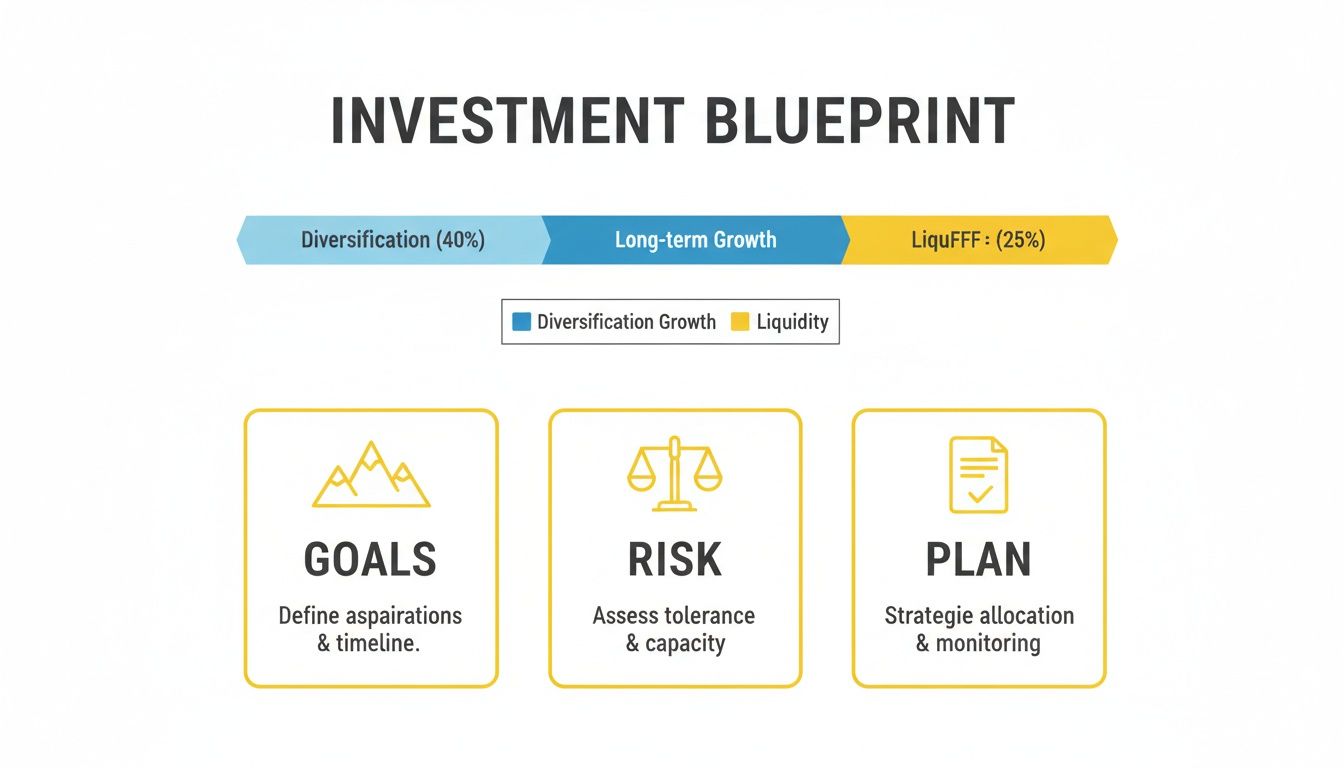
As you can see, a solid portfolio isn't built on a whim. It’s a deliberate plan where each piece connects, starting with what you want to achieve financially.
Finding Your Ideal Mix of Stocks and Bonds
The way you split your money between stocks and bonds will be the main driver of both your returns and your portfolio's volatility. Stocks are your growth engine, but they come with a bumpy ride. Bonds, on the other hand, provide stability and income, acting like a shock absorber when the market gets rocky.
A younger investor with decades until retirement can afford to take on more risk for a shot at higher returns. For example, a 25-year-old saving for retirement might go with a portfolio that is 90% stocks and 10% bonds. This aggressive approach gives them plenty of time to ride out market swings and harness the power of compounding growth.
On the flip side, someone getting close to retirement needs to focus more on protecting what they've built. A 60-year-old might choose a more conservative 50% stock, 50% bond mix to dial down the risk and secure their nest egg. If you want to dive deeper into getting this mix just right, you can check out our guide to optimize your portfolio with smart asset allocation.
To give you a clearer picture, here are a few common asset allocation models based on different investor profiles.
Sample Asset Allocation Models by Risk Profile
This table shows how you can adjust your stock and bond mix based on your personal comfort with risk and your investment timeline.
| Risk Profile | Stocks (Equities) % | Bonds (Fixed Income) % | Ideal For |
|---|---|---|---|
| Conservative | 20% – 40% | 60% – 80% | Investors with a short time horizon or very low risk tolerance who prioritize capital preservation. |
| Moderate | 50% – 70% | 30% – 50% | Investors with a medium-to-long time horizon seeking a balance between growth and stability. |
| Aggressive | 80% – 100% | 0% – 20% | Investors with a long time horizon (10+ years) who can tolerate significant market fluctuations for higher potential returns. |
Remember, these are just starting points. Your personal situation is unique, so feel free to tweak these percentages to better match your own financial DNA.
The Non-Negotiable Role of Diversification
Once you’ve settled on your high-level split between stocks and bonds, the next crucial step is diversification. This is the age-old wisdom of not putting all your eggs in one basket, and it's absolutely fundamental to building a resilient portfolio.
But true diversification is more than just owning a few stocks and a few bonds.
Expert Insight: Studies have shown that asset allocation is responsible for over 90% of a portfolio's return variability over time. The specific stocks you pick matter far less than your overall asset mix.
You have to diversify within each of those categories. For the stock portion of your portfolio, that means spreading your money across:
- Company Size: Don't just load up on household names like Apple and Microsoft. You need a mix of large-cap, mid-cap, and small-cap companies. Each brings a different risk and growth profile to the table.
- Industries and Sectors: If your portfolio is 75% tech stocks, you’re in for a world of hurt when that sector inevitably hits a slump. Balance things out with exposure to healthcare, financials, consumer goods, and industrial companies.
- Geographic Regions: Sticking only to U.S. stocks is a huge, unforced error. You’re exposing yourself to the fate of a single country's economy and political climate.
Think about it: the U.S. stock market makes up less than half of the entire world's market value. A U.S.-only portfolio is ignoring more than 50% of the global investment opportunities out there. Historically, international and U.S. markets tend to perform well at different times. Adding international exposure can help smooth out your portfolio's performance and make you less dependent on any single economy.
By combining a smart asset allocation with deep diversification, you’re not just building a portfolio for growth. You’re building one that's designed to weather the inevitable storms the market will throw its way.
Selecting the Right Investments for Your Goals
Okay, you've got your asset allocation blueprint. Now comes the fun part: picking the actual investments that will bring your portfolio to life. This is where the rubber meets the road, moving from high-level strategy to selecting the specific building blocks. Your main choices boil down to individual stocks, exchange-traded funds (ETFs), and mutual funds—and each comes with its own personality.
The path you choose here is a big deal. It will dictate how hands-on you need to be, how much diversification you get right away, and what you’ll pay in fees. Ultimately, it’s the difference between being a stock picker and being a portfolio architect.
Individual Stocks vs. Funds: A Critical Choice
When you buy individual stocks, you’re becoming a direct owner of a company. Picking up shares of Apple (AAPL) is a bet on their next iPhone or service. Buying Johnson & Johnson (JNJ) is an investment in a healthcare titan you believe will stand the test of time.
This approach gives you the highest potential upside, but it also packs the most risk. A single stock can make you a hero, but it can just as easily become a zero—just ask anyone who held stock in Enron or Sears. To succeed, you have to be willing to do the homework: digging into financial statements, understanding competitive advantages, and keeping up with industry news.
On the other side of the coin are ETFs and mutual funds. These are baskets that hold hundreds or even thousands of stocks in a single, easy-to-trade package. An S&P 500 ETF, for example, instantly makes you a part-owner of the 500 biggest companies in the U.S. This gives you immediate diversification, which is the secret sauce for building a portfolio that can handle market turbulence.
Here’s how that plays out in the real world: Let's say you have $1,000 to invest. You could buy about three shares of a company like Microsoft. Or, you could put that same $1,000 into an S&P 500 ETF and instantly have a tiny piece of Microsoft, Apple, Amazon, and 497 other top businesses. The ETF route drastically cuts down your single-company risk.
Comparing Your Investment Options
To figure out what’s right for you, it helps to see these options side-by-side. Each one serves a different purpose and fits a different kind of investor.
| Feature | Individual Stocks | ETFs (Exchange-Traded Funds) | Mutual Funds |
|---|---|---|---|
| Control | High. You call all the shots, deciding exactly which companies you own. | Moderate. You pick the fund, but an index or manager chooses the stocks inside. | Low. A professional fund manager makes all the buy and sell decisions. |
| Diversification | Low. You have to buy many different stocks on your own to be diversified. | High. One share can give you exposure to hundreds of companies. | High. Offers broad diversification, much like an ETF. |
| Cost | Low. Most brokers offer commission-free trades. No management fees. | Very Low. Index ETFs often have expense ratios below 0.10%. | Varies. Can be low (for index funds) or high (for actively managed funds). |
| Best For | Investors who love doing deep research and are comfortable with higher risk. | Hands-off investors who want low-cost, instant diversification. | Investors who want professional management, but often at a higher cost. |
For most people starting out, low-cost index ETFs are the most direct and effective way to get in the game. If you want to go deeper on this, you can learn more about what are index funds and see why they’ve become such a popular tool for building wealth.
Growth vs. Value Stocks
Whether you're picking stocks yourself or looking at what's inside an ETF, you'll constantly run into two core investing philosophies: growth and value.
-
Growth Stocks: These are companies that are expected to grow much faster than the rest of the market. Think of flashy tech innovators or biotech firms that pour every penny of profit back into expansion. They rarely pay dividends and their stock prices can be a rollercoaster, but the potential for huge gains is what draws people in.
-
Value Stocks: These are the reliable, steady players—established companies that might be trading for less than they're truly worth. They’re often in mature industries like banking or consumer goods, generate predictable profits, and usually pay regular dividends. Think of them as the workhorses of a portfolio.
A solid portfolio usually has a bit of both. Growth stocks can be the engine for big returns, while value stocks provide stability and income. It's all about creating balance.
A Simple Checklist for Vetting Any Investment
Before you pull the trigger on any asset—whether it's a single stock or an ETF—run it through this quick mental checklist. This isn't about building complex spreadsheets; it's about asking some simple, common-sense questions to stay out of trouble.
- Do I actually understand this? If you can't explain what a company does in one sentence, you probably shouldn't own it. For an ETF, this means knowing what it tracks (e.g., S&P 500, NASDAQ 100).
- Does it have a competitive "moat"? A moat is a durable advantage that protects a business from competitors. It could be a powerful brand like Coca-Cola, a network effect like Meta, or a low-cost advantage.
- Are the finances solid? Look for a track record of growing revenue and debt that's under control. A company drowning in debt is a huge red flag.
- What are the fees? For an ETF or mutual fund, the expense ratio is everything. A high fee is a guaranteed drag on your returns, year after year. When comparing similar funds, always lean toward the lower-cost option.
Using this simple framework helps you make sure every investment you buy is a quality asset that truly fits with your long-term plan.
Putting Your Plan Into Action
A brilliant investment strategy on paper is useless until you actually put it to work. Now that you've defined your goals and picked your investments, it's time to get practical. This is all about building a sustainable routine for managing your portfolio—one that helps you stick to your plan, avoid the temptation of obsessively checking charts, and make decisions based on logic, not market noise.

Making Your First Trades
First things first, you'll need a brokerage account. These days, opening one is a breeze online with major platforms like Fidelity, Charles Schwab, or Vanguard. Once you've funded your account, you're ready to start placing orders for your chosen stocks or ETFs.
Right away, you'll encounter a fundamental choice between two main order types.
- Market Order: This is the most straightforward option. It tells your broker to buy or sell an investment right now at the best available price. A market order is all about speed—it guarantees the trade will happen, but it doesn't guarantee the exact price you'll get.
- Limit Order: This gives you much more control. You set the exact price you're willing to pay for a stock or the minimum price you'll accept to sell it. Your order will only go through if the stock hits your specified price or better.
Here's a quick example: Let's say you want to buy an ETF that's bouncing around the $100 mark. A market order might get filled at $100.02. But if you place a limit order at $99.50, your broker will only execute the purchase if the price dips to that level or lower, protecting you from overpaying.
The All-Important Discipline of Rebalancing
Once you’ve built your portfolio, it's not going to stay perfectly balanced forever. Some assets will grow faster than others, and over time, this "portfolio drift" can quietly throw your entire asset allocation out of whack. This is where the crucial discipline of rebalancing comes in.
Rebalancing is simply the act of periodically buying or selling assets to get your portfolio back to its original target allocation. Think of it as a forced, systematic way to "buy low and sell high"—you're trimming profits from your top performers and reinvesting that cash into the assets that have lagged.
Imagine you started with a 70/30 portfolio (70% stocks, 30% bonds). After a great year for the stock market, you might find your portfolio has drifted to an 80/20 split. Suddenly, your portfolio is carrying more risk than you originally signed up for. Rebalancing here would mean selling some stocks to lock in those gains and using the proceeds to buy more bonds, bringing you back to your 70/30 comfort zone.
How Often Should You Rebalance?
There’s no single "perfect" rebalancing schedule, but a couple of common-sense approaches work well for most investors. The most important thing is to pick a method and be consistent.
| Rebalancing Strategy | How It Works | Pros | Cons |
|---|---|---|---|
| Time-Based | You review and rebalance your portfolio on a set schedule, like once a year, every six months, or quarterly. | Simple, easy to remember, and enforces discipline. It's a "set it and forget it" approach. | You might miss big market swings that happen between your scheduled dates. |
| Threshold-Based | You only rebalance when an asset class drifts from its target by a specific amount (e.g., 5% or 10%). | More responsive to the market, ensuring your risk level never gets too far out of line. | Requires you to monitor your portfolio more closely and could lead to more frequent trading. |
A great middle ground is a hybrid approach: check your portfolio on your birthday or New Year's Day, but only pull the trigger on a rebalance if an asset class is off by more than 5%. Many savvy investors also use new contributions to rebalance, simply directing their fresh cash into whatever asset class is lagging. This is a smart way to get back on track without having to sell anything and potentially trigger taxes.
This disciplined routine is your best defense against emotional reactions to market volatility. It helps to keep historical returns in perspective. While the S&P 500 has averaged an impressive 10.463% annual return over the last century, it rarely hits that average. In fact, between 1926 and 2018, its annual return landed within 2 percentage points of that average only six times. You can see more data on historical stock market averages on Trade That Swing. This wild fluctuation is exactly why a long-term plan, anchored by systematic rebalancing, is so vital for success.
Don't forget the power of consistent contributions. You can master dollar-cost averaging for steady wealth growth by investing a set amount on a regular schedule. It's a wonderfully simple way to automate the process of buying more shares when prices are low and fewer when they're high.
Avoiding the Big Mistakes: Your Guide to Investor Self-Defense
You can build the most mathematically perfect stock portfolio in the world, but your biggest threat isn't a market crash—it's the person in the mirror. Human psychology is a minefield for investors, littered with behavioral traps that can wreck even the most brilliant strategies.
Knowing how to build a portfolio is half the battle. The other half is mastering your own emotions. Fear and greed are powerful forces that cause smart people to make very costly mistakes. Let's walk through the most common ones so you can spot them and steer clear.
Don't Panic Sell When the Market Dips
When your portfolio is a sea of red, every instinct screams "Sell! Stop the pain!" But acting on that impulse is almost always the worst thing you can do.
Panic selling does two terrible things: it locks in your losses permanently and benches you during the inevitable recovery. Market downturns aren't a sign of failure; they're a normal part of the investing cycle. For a long-term investor, they should be viewed as buying opportunities, not a catastrophe.
Real-World Scenario: Cast your mind back to March 2020. As the pandemic took hold, markets plummeted. Investors who panicked and sold off their holdings locked in devastating losses of 20-30%. Those who stayed calm—or even kept buying—watched their portfolios not only recover but surge to new all-time highs within a few short months.
Don't Chase "Hot" Stocks or Fleeting Trends
It's so easy to get caught up in the hype around the latest "it" stock. Whether it's a revolutionary tech company or a meme stock soaring on social media chatter, investing based on FOMO (Fear Of Missing Out) is a fast track to disappointment.
Here’s the thing: by the time you hear about it on the news, the smart money has likely already made its profit and is looking for the exit. Chasing performance means you're buying high, and when the hype fizzles out, you'll be tempted to sell low. Stick to your own well-researched plan. For a deeper dive into this and other common errors, check out our guide on common investment mistakes that destroy wealth.
Don't Bet the Farm on a Single Stock
Going all-in on that one company you know is going to be the next big thing feels exciting, but it's a massive, unforced error. Putting more than 10-20% of your portfolio into one stock exposes you to what's called idiosyncratic risk. That's a fancy way of saying one piece of bad news—a failed product, a corporate scandal—could cripple your entire net worth.
We’ve all heard the horror stories. Think of employees at companies like Enron who had their life savings tied up in company stock, only to see it all vanish. Proper diversification across dozens of companies, sectors, and even countries is your best defense against this kind of disaster.
To keep these behavioral traps front of mind, here’s a quick summary of the most frequent pitfalls investors face and, more importantly, how to sidestep them.
Common Investing Mistakes and How to Avoid Them
The table below breaks down frequent blunders made by new and experienced investors alike. Use it as a checklist to keep your strategy disciplined and on track for success.
| Common Mistake | Why It's Harmful | How to Avoid It |
|---|---|---|
| Emotional Decisions | Letting fear or greed drive your choices leads to buying high and selling low, destroying long-term returns. | Create a written investment plan and stick to it. Automate your investments to remove emotion from the process. |
| Ignoring High Fees | High expense ratios and trading fees act as a constant drag on your portfolio, silently eating away at your gains. | Prioritize low-cost index funds and ETFs. Understand the fee structure of your brokerage account and investments. |
| Lack of Diversification | Putting all your eggs in one basket (one stock, one sector) exposes you to unnecessary and potentially catastrophic risk. | Build a portfolio with a mix of stocks, bonds, and international assets. Use ETFs for instant, broad diversification. |
Ultimately, developing the right mindset and sticking to your plan is what separates successful investors from the rest. By learning to sidestep these psychological traps, you can stay firmly on the path to achieving your financial goals.
Your Questions About Building a Portfolio Answered
Getting started with investing always kicks up a lot of questions. It’s completely normal. Let's walk through some of the most common ones so you can move forward with building your portfolio with confidence.
1. How much money do I really need to start building a stock portfolio?
Forget the old myth that you need a fortune to invest. These days, thanks to zero-commission trading and fractional shares, you can get in the game with as little as $50 or $100. The starting amount isn't what matters. What truly builds wealth is the habit of investing consistently over time, no matter how small you start.
2. Should I invest a lump sum or invest gradually over time?
This is the classic debate: go all-in now (lump-sum) or ease in over time (dollar-cost averaging, or DCA)? On paper, historical data shows lump-sum investing often comes out slightly ahead because your money gets more time in the market to grow. However, DCA is an incredibly powerful real-world strategy. By investing a fixed amount on a regular schedule (say, every two weeks), you smooth out your purchase price and build discipline.
3. How often should I check my portfolio?
For your own sanity and long-term success, as little as possible. Daily check-ins trigger emotional, knee-jerk reactions to normal market swings. For a long-term investor, a quarterly or semi-annual check-in is plenty. This is the perfect cadence to rebalance if needed and ensure you’re on track without getting lost in the daily noise.
4. What’s the difference between an ETF and a mutual fund?
Both are baskets of investments that provide instant diversification, but they trade differently. ETFs (Exchange-Traded Funds) trade like stocks, with prices that fluctuate throughout the day. They are known for low fees and tax efficiency. Mutual Funds are priced only once per day, after the market closes, and can sometimes carry higher fees, especially if they are actively managed.
5. Should I just use a robo-advisor to build my portfolio?
A robo-advisor can be a brilliant choice, especially for beginners. You answer questions about your goals and risk tolerance, and it automatically builds and manages a diversified portfolio for you. It's a completely hands-off way to put good investing habits on autopilot, taking care of diversification and rebalancing so you don't have to.
6. What is a good return for a stock portfolio?
A "good" return is whatever helps you reach your financial goals. However, a common benchmark is the historical average of the S&P 500, which has returned around 10% annually over the long run. Remember, this is an average—some years are much higher, and others are negative. Aiming to match the market's long-term performance is a solid, realistic goal.
7. Are bonds still a good investment in a stock portfolio?
Absolutely. Bonds are the shock absorbers for your portfolio. They provide stability and reliable income, which is incredibly valuable when the stock market inevitably hits a rough patch. Their job isn't to deliver huge gains like stocks; it's to provide balance and reduce overall portfolio volatility.
8. How should I handle a market crash?
First, don't panic. Crashes and corrections are a normal part of investing. As long as your time horizon and financial situation haven't fundamentally changed, the best move is often no move at all. Sticking with your plan and continuing to invest during a downturn means you're buying quality assets at a discount. It can feel scary, but it’s how long-term wealth is built.
9. Do I need a financial advisor to build a portfolio?
Not necessarily. With the tools and information available today, millions of people successfully manage their own portfolios using simple, low-cost index funds and ETFs. However, a good financial advisor can be invaluable if your financial life is complex, you lack the time or confidence, or you simply want professional guidance.
10. How are my investments taxed?
This depends on two main factors: the type of account you use and how long you hold an investment. Retirement accounts like a 401(k) or IRA offer tax advantages (tax-deferred or tax-free growth). In a regular brokerage account, if you sell an investment held for more than a year, your profit is taxed at the lower long-term capital gains rate.
At Top Wealth Guide, we provide the insights and strategies you need to build and manage your wealth effectively. Whether you're just starting out or looking to refine your approach, our resources are designed to help you succeed.
Explore proven tactics and enhance your portfolio today at Top Wealth Guide
This article is for educational purposes only and is not financial or investment advice. Consult a professional before making financial decisions.
