

Building generational wealth is about more than just leaving an inheritance. It’s a deliberate strategy for creating a financial legacy that can provide security, opportunity, and a tangible head start for your children, grandchildren, and even beyond. This isn't a get-rich-quick scheme. It’s about building a sustainable system of assets, knowledge, and values designed to stand the test of time.
This guide provides an in-depth, practical framework based on years of financial planning experience, moving beyond surface-level advice to offer actionable strategies. Our goal is to leave you feeling confident that you have the information needed to start building a lasting legacy for your family.
In This Guide
- 1 What Does Generational Wealth Actually Mean?
- 2 Building Your Long-Term Investment Engine
- 3 How to Protect Your Wealth from Taxes and Risks
- 4 Designing Your Legacy with Smart Estate Planning
- 5 Passing On More Than Just Money: Instilling Financial Wisdom
- 6 Frequently Asked Questions (FAQ) about Creating Generational Wealth
- 6.1 1. What's the minimum amount of money I need to start creating generational wealth?
- 6.2 2. How do I teach my kids about money without making them feel entitled?
- 6.3 3. Is real estate a better investment than stocks for long-term growth?
- 6.4 4. Do I really need a trust if I already have a will?
- 6.5 5. What's the biggest mistake families make when trying to pass on wealth?
- 6.6 6. How often should I review my estate plan?
- 6.7 7. What role does life insurance play in a generational wealth strategy?
- 6.8 8. How can I protect my family's assets from future creditors or lawsuits?
- 6.9 9. What is a family mission statement and why do we need one?
- 6.10 10. Should I tell my children the exact amount of their inheritance?
What Does Generational Wealth Actually Mean?
At its heart, pursuing generational wealth requires a fundamental shift in your thinking. You’re moving from planning for your own retirement to creating a multi-generational vision. This isn't about setting up a massive trust fund that gets blown in a few years; it’s about crafting a durable financial engine that can support your family for decades.
A common myth is that this is a game reserved for the ultra-wealthy. The reality is that the journey starts with a solid plan and consistent action, regardless of your current income. It’s as much about protecting what you build and teaching your heirs to be responsible stewards as it is about accumulating assets in the first place.
The Pillars of a Lasting Legacy
A solid generational wealth strategy stands on four key pillars. If one is weak, the whole structure is at risk.
- Financial Accumulation: This is the growth engine. It’s all about smart investing in assets that appreciate over the long haul—think stocks, real estate, and private businesses.
- Wealth Protection: You have to play defense. This means shielding your assets from taxes, potential lawsuits, and market volatility using legal tools like trusts and the right kinds of insurance.
- Knowledge Transfer: Honestly, this might be the most important part. You must equip the next generation with financial literacy. A staggering 90% of wealthy families lose their fortune by the third generation, often because the heirs simply weren't prepared to manage it.
- Value Alignment: Money without purpose is just… money. Defining what your family stands for and maintaining open communication about goals and responsibilities is what makes a legacy meaningful. A rich life is about more than just the numbers in an account, a topic we explore in our guide on how to define wealth beyond money and possessions.
Generational wealth is ultimately about creating freedom. It’s the freedom from financial stress, the freedom to get an education without crushing debt, and the freedom to take smart risks, like starting a new business.
Core Components of a Generational Wealth Strategy
To give you a clearer picture, here's a breakdown of how these components work together. Getting these pillars right is the difference between a one-time inheritance and a true multi-generational legacy.
| Pillar | Primary Goal | Key Actions | Common Pitfall |
|---|---|---|---|
| Financial Growth | Consistently increase the family's net worth. | Diversified investing (stocks, real estate), entrepreneurship, compounding. | Over-concentration in one asset or chasing fads. |
| Asset Protection | Shield wealth from taxes, creditors, and bad luck. | Trusts, LLCs, proper insurance, and strategic titling of assets. | Assuming a basic will is enough protection. |
| Financial Education | Prepare heirs to be responsible stewards. | Family meetings, financial literacy programs, involving them in decisions. | Keeping money secrets and avoiding the conversation. |
| Legacy & Values | Ensure the wealth serves a purpose beyond spending. | Creating a family mission statement, philanthropic planning, governance. | Lack of a shared vision or family disputes. |
Why This Matters Now
We are living through a massive financial event known as the "Great Wealth Transfer." Over the coming years, trillions of dollars will move from Baby Boomers to their heirs. This is a once-in-a-lifetime opportunity. Families who get proactive now—by setting up smart strategies—can not only receive and protect this wealth but also position it to grow for generations, breaking old cycles of financial struggle for good.
Building Your Long-Term Investment Engine
Think of your investment portfolio as the engine that will power your family’s wealth for decades to come. A well-built engine doesn't just run; it endures, adapts, and gains strength over time. This means looking past short-term market noise and focusing on a resilient collection of assets designed to grow for 50 years or more.
The magic behind this is compound interest—the incredible process where your investment returns start generating their own returns. Over a long enough timeline, this effect is an absolute powerhouse, turning steady contributions into a substantial legacy. The secret is to start early, automate everything you can, and keep that engine fueled.
This whole process is a journey, starting with smart investing, moving on to protecting what you've built, and finally, teaching the next generation how to keep the cycle going.
Assembling Your Core Portfolio
The bedrock of any generational wealth plan must be built on reliable, time-tested assets. These are the workhorses that deliver steady growth and stay strong even when the market gets shaky.
- Broad Market Index Funds (S&P 500, Total Stock Market): This is the simplest, most effective way to own a slice of the entire economy. Instead of gambling on individual companies, you’re betting on the long-term growth of the market itself. They're cheap, easy, and have historically delivered powerful returns, averaging around 10% annually over the long haul.
- Dividend-Paying Stocks: These are shares in established, profitable companies that send a piece of their earnings back to you. For a multi-decade strategy, reinvesting those dividends automatically buys you more shares, which then pay more dividends, kickstarting a powerful compounding cycle.
- Real Estate: Tangible assets are crucial. Whether it's residential or commercial property, real estate has been a cornerstone for wealthy families for centuries. It provides consistent rental income (cash flow), appreciates in value over time, and comes with significant tax advantages. It’s not as liquid as a stock, but it provides a vital layer of diversification.
This mix of stocks and property creates a powerful balance of growth, income, and real-world stability—exactly what you need for a portfolio that's meant to last.
Adding Growth and Diversification
Once your foundation is solid, it's time to add satellite assets. These are strategic additions that offer a shot at higher growth or act as a hedge during economic uncertainty. Just remember to keep these as a smaller, more targeted part of your overall portfolio.
You might want to explore:
- Growth Stocks: Innovative companies in cutting-edge sectors like technology or biotechnology. They can produce incredible returns but come with higher volatility.
- Private Equity or Venture Capital: This involves investing in private companies before they hit the stock market. It’s a high-stakes game that requires significant capital and patience, but the potential payoff can be massive.
- Alternative Investments: Assets like fine art, precious metals (especially gold), or even rare collectibles can be a great way to store value. They often perform well during periods of high inflation when cash is losing its buying power.
The key isn't to chase every hot trend. It's about building a balanced portfolio where different assets zig while others zag. When stocks are having a rough year, your real estate or gold might be holding strong.
Real-Life Example: The Johnson Family's Portfolio
To make this concrete, let's consider a hypothetical family, the Johnsons, who started their generational wealth journey 30 years ago.
- The Foundation (70%): They consistently invested in a low-cost S&P 500 index fund and a dividend growth ETF. This core holding grew steadily through market ups and downs.
- The Cash Cow (20%): They purchased a duplex in a growing neighborhood. The rental income paid off the mortgage over 25 years and now generates pure cash flow, while the property's value has more than tripled.
- The Growth Bet (10%): In the early 2000s, they allocated a small portion to a technology-focused mutual fund. This part of the portfolio saw extreme growth, significantly boosting their overall net worth despite its smaller allocation.
Today, their diversified engine supports their retirement, funds their grandchildren's education accounts, and is structured to pass on efficiently.
Comparing Investment Vehicles for Your Legacy
There's no single "perfect" portfolio—the right mix of assets is deeply personal and depends on your family's risk tolerance, timeline, and specific goals. As you piece together your strategy, understanding how to effectively manage your wealth for long-term growth is critical for making smart adjustments along the way.
This table helps you weigh the pros and cons of each major asset class.
| Investment Vehicle | Long-Term Growth Potential | Typical Risk Profile | Hands-On Effort Required | Best Suited For |
|---|---|---|---|---|
| Index Funds | High | Medium | Low | Building a low-cost, diversified, and automated foundation. |
| Dividend Stocks | Medium to High | Medium | Low to Medium | Generating passive income and benefiting from compounding. |
| Real Estate (Rental) | Medium to High | Medium | High | Creating cash flow, tax benefits, and holding a hard asset. |
| Alternative Investments | Varies Widely | High | Medium to High | Hedging against inflation and diversifying away from markets. |
Building this investment engine is a marathon, not a sprint. It's about strategic allocation and, most importantly, consistent contributions over many years. By combining that stable, foundational core with a few carefully chosen growth opportunities, you're creating a portfolio that can weather any storm and truly power your family's financial future for generations.
How to Protect Your Wealth from Taxes and Risks
https://www.youtube.com/embed/xZugaZgELZU
Building a substantial portfolio is a monumental achievement, but frankly, it’s only half the job. Without a solid defense, your hard-earned assets can be seriously eroded by taxes, lawsuits, and the inevitable curveballs life throws. Protecting your wealth is what ensures your legacy actually makes it to the next generation intact.
This isn’t about shadowy tax evasion; it's about smart, completely legal tax avoidance. The goal is to use the financial tools the system provides to keep more of your money working for your family instead of sending it to the government. Think of it as building a financial fortress around the assets you've worked so hard to build.
Strategic Tax Minimization for Your Legacy
Taxes are one of the single biggest threats to building multi-generational wealth. Between income tax, capital gains, and estate taxes, the government can take a huge slice of your assets if you're not planning ahead. Luckily, there are powerful strategies you can put in place to keep that from happening.
A great place to start is by maxing out tax-advantaged retirement accounts. Everyone knows about the 401(k), but the Roth IRA is a true legacy-building powerhouse. You contribute with after-tax money, which means every penny of growth and all withdrawals down the road are completely tax-free. This creates a pool of money that can grow for decades without ever seeing a tax bill again.
Beyond retirement accounts, you need to look at trusts. An Irrevocable Trust, for example, is a fantastic vehicle for moving assets out of your taxable estate. Once you transfer assets into the trust, they are generally shielded from estate taxes and, in many cases, from creditors, making sure they are preserved for your beneficiaries exactly as you intended.
The best wealth protection plans are proactive, not reactive. You build the walls of your fortress long before a storm ever appears on the horizon. That means planning for taxes and risks today, not when a crisis is already unfolding.
Building a Shield with the Right Insurance
Risk management is the unsung hero of any generational wealth plan. Life is unpredictable. A single unexpected event—a serious illness, a nasty lawsuit, or a premature death—can completely derail decades of careful financial work. The right insurance policies are your shield against these potential catastrophes.
Here’s a quick rundown of the coverage that really matters:
- Life Insurance: A permanent life insurance policy does more than just pay out when you pass away; it provides a tax-free death benefit to your heirs. This gives them immediate cash to pay for estate taxes or debts without being forced to sell off important assets like the family business or real estate.
- Disability Insurance: Your ability to earn an income is your most valuable asset, period. Disability insurance protects that income stream if you're hurt or sick and can't work, ensuring your family's financial plan doesn't get derailed.
- Umbrella Insurance: This is a surprisingly affordable layer of liability protection that kicks in when your standard home or auto insurance limits are maxed out. One major lawsuit could otherwise wipe you out, making this coverage a non-negotiable for anyone with significant assets to protect.
Comparing Key Wealth Protection Tools
It's crucial to understand which tool to use for which job. A will is not a trust, and a Roth IRA serves a completely different tax purpose than a traditional 401(k). This table breaks down the primary function of each key component in your wealth protection arsenal.
| Protection Tool | Primary Purpose | How It Works for Generational Wealth |
|---|---|---|
| Irrevocable Trust | Asset Protection & Estate Tax Reduction | Moves assets out of your name, shielding them from creditors and reducing the size of your taxable estate for heirs. |
| Roth IRA | Tax-Free Growth & Withdrawals | Allows investments to grow and be withdrawn tax-free, creating a powerful, tax-sheltered inheritance for beneficiaries. |
| Umbrella Insurance | Liability Protection | Provides extra coverage against major lawsuits, preventing personal assets from being seized to pay a judgment. |
| Permanent Life Insurance | Liquidity & Tax-Free Transfer | Delivers a tax-free lump sum to heirs, covering estate taxes and preserving core family assets for the long term. |
Protecting your wealth isn't a one-and-done task; it's an ongoing process of strategic planning. By minimizing your tax burden with smart account choices and shielding your assets with the right insurance, you ensure that the legacy you build is the one that actually gets passed on. For those looking to optimize their investment strategy further, understanding different capital gains tax strategies can provide an additional layer of financial efficiency.
Designing Your Legacy with Smart Estate Planning
After all the years of disciplined saving, smart investing, and careful risk management, we arrive at the final, crucial piece of the generational wealth puzzle: making sure your legacy passes to the next generation smoothly and exactly as you intended.
Many people think of estate planning as a grim, complicated chore to be put off. I see it differently. It's the ultimate act of control over your life's work. It's you, at the helm, charting the course for your family's future. Without a plan, you’re handing the reins over to the courts. That’s a recipe for a public, expensive, and often painful process that can tear families apart. A thoughtfully designed estate plan isn't just about documents; it's about giving your family—and yourself—peace of mind.

Wills vs. Trusts: Understanding the Core Tools
Every estate plan needs a foundation, and that’s typically a will. A will is your instruction manual for distributing assets and naming guardians for your children. But for a true generational wealth strategy, a will alone often falls short. Why? Because it has to go through probate—a court-supervised process that can freeze assets for months, sometimes years.
This is where a trust becomes so powerful. Think of a trust as a private entity you create to hold your assets for your beneficiaries, managed by a trustee you choose. The real magic is that a properly funded trust completely bypasses probate, allowing your assets to transfer privately and immediately.
Real-Life Example: The Garcia Family's Estate Plan
Consider the Garcias, who own a successful small business and a few rental properties.
- Without a Trust: If they only had wills, their business operations could be frozen upon their death until the probate court validates the will and appoints an executor. This delay could jeopardize contracts, payroll, and the business's very survival. Their children would have to wait months or years to access their inheritance.
- With a Trust: The Garcias placed their business and properties into a Revocable Living Trust. Upon their passing, their designated successor trustee (their eldest daughter, who is also a CPA) can step in immediately to manage the business without any court intervention. The transfer of assets is seamless, private, and efficient, preserving the legacy they built.
Here’s a quick breakdown of how they stack up:
| Feature | Last Will and Testament | Revocable Living Trust |
|---|---|---|
| Probate | Required. Assets are tied up until a court signs off. | Avoided. Assets can transfer to your heirs almost immediately. |
| Control | Names who gets what, but your control ends at your death. | Lets you set specific conditions on how and when assets are used. |
| Privacy | Becomes a public record for anyone to see after probate. | Stays completely private, protecting your family's financial details. |
| Cost | Cheaper to set up, but probate can rack up serious legal fees. | Costs more upfront, but saves your family a fortune by avoiding probate. |
For most people building significant wealth, the winning combination is often using both a will and a trust to create a comprehensive, protective shield.
Essential Documents Beyond the Will
A solid estate plan doesn't just kick in when you're gone—it protects you while you're alive, too. If you become unable to make decisions for yourself, these documents are non-negotiable.
- Durable Power of Attorney: This is where you name someone you trust implicitly to handle your financial life if you can't. Without it, your family would have to go to court just to get the authority to pay your bills or manage your portfolio.
- Healthcare Directive (Living Will): This document spells out your wishes for medical treatment if you're incapacitated. It’s an incredible gift to your loved ones, freeing them from the agonizing burden of guessing what you would have wanted.
These aren't just for the elderly. Any adult who owns assets needs these in place.
So many people make the mistake of treating estate planning as a "set it and forget it" task. Your plan must be a living document. I tell my clients to pull it out and review it every 3-5 years, or anytime a major life event happens—a marriage, a new baby, a big promotion, or a divorce.
The Overlooked Power of Beneficiary Designations
Here’s one of the simplest and most commonly fumbled parts of estate planning: beneficiary designations. I'm talking about the names you list on your 401(k)s, IRAs, and life insurance policies. These designations are legally binding contracts that override your will.
I’ve seen it happen: someone gets divorced, forgets to update their 401(k) beneficiary, and their life savings end up going to an ex-spouse instead of their children. It’s an absolute nightmare that is preventable with a five-minute check-up. For more on syncing these critical details, our guide on how to transfer wealth to the next generation effectively dives deeper.
This planning is more important than ever as we witness the "Great Wealth Transfer." An estimated $124 trillion is set to change hands between generations in the U.S. alone over the next few decades, according to reporting from Fortune. Families who have a clear, intentional plan in place will be the ones who successfully receive, protect, and continue to grow that legacy.
By designing your legacy today, you give your loved ones the most powerful gift of all: clarity and security for their future.
Passing On More Than Just Money: Instilling Financial Wisdom
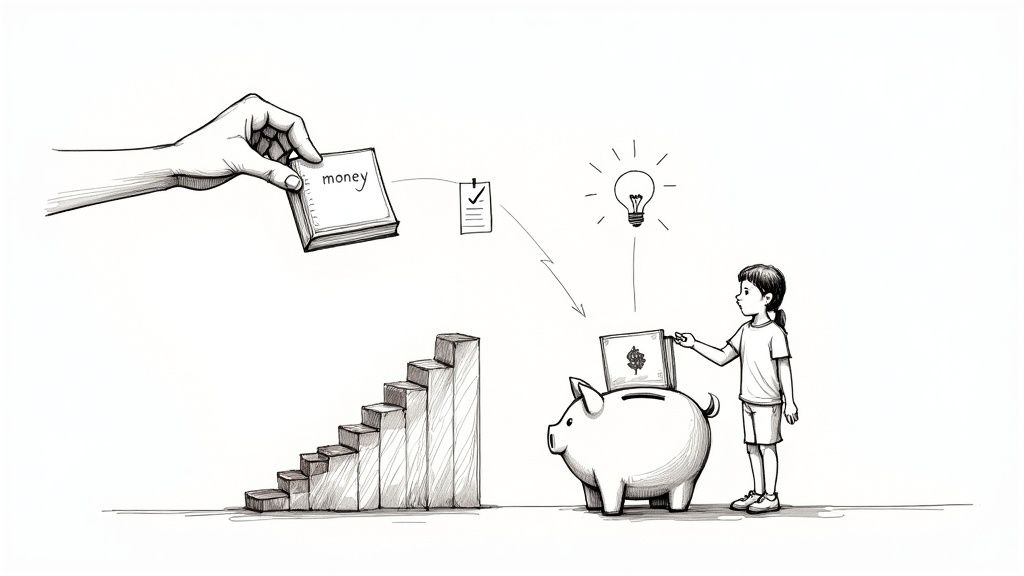
Here’s a hard truth I’ve seen play out too many times: money transferred without wisdom is almost always lost. An investment portfolio can compound for decades, but an unprepared heir can burn through that growth in a handful of years. The real, and often harder, work is preparing your family to be capable stewards of the legacy you're building.
This human element—the education and shared values—is the glue that holds a multi-generational financial plan together. It’s what transforms a simple inheritance into a lasting foundation for opportunity. That old saying, "shirtsleeves to shirtsleeves in three generations," isn't just a myth; it's a stark warning against focusing only on assets while ignoring the mindset needed to keep them.
Cultivating Financial Literacy from a Young Age
Financial education isn't a one-time lecture. It’s a conversation that starts early and evolves as your kids grow up. The goal is to demystify money, making it a normal, healthy part of life.
Here's a practical, age-based framework:
- Ages 5-8 (The Basics): Ditch the piggy bank for a clear jar. Actually seeing the money pile up makes the concept of saving tangible. Set up three jars: one for Saving, one for Spending, and one for Giving.
- Ages 9-12 (Making Choices): Introduce a small allowance tied to extra responsibilities, not just expected chores. This is a crucial first lesson that money is earned. Help them set a savings goal for a toy or game they really want to teach delayed gratification.
- Ages 13-17 (Earning and Investing): Encourage a part-time job so they can experience earning their own income. Then, open a custodial Roth IRA and offer to match what they contribute. This provides a powerful, hands-on lesson in the magic of compounding.
The most impactful lessons come from involvement, not lectures. Letting a teenager research two or three index funds for their own account teaches them more about investing than any book ever could.
This kind of early exposure is more critical than ever. We're on the cusp of a massive generational wealth shift. By 2040, younger generations are projected to make up 80% of the ultra-wealthy population, a massive jump from today's 33%. These future inheritors think differently about money, and we need to adapt. You can see how the world's richest are already adjusting their strategies by reading this analysis of how they are investing their fortunes.
Once the wealth—and the family—starts to grow, quiet chats about money just don't cut it anymore. You need a more structured framework, a system of family governance, to keep everyone on the same page and ensure decisions are made with care.
It all starts with a Family Mission Statement. This isn't about the numbers; it's about the purpose. It forces you to answer the big questions: What do we stand for? What is this wealth ultimately for? Is it to fund education, spark entrepreneurship, or fuel philanthropic causes?
With a clear mission in hand, regular family meetings become the place to bring it to life. These don’t have to be stuffy boardroom sessions. Think of them as opportunities to review shared goals, celebrate wins, and talk openly about challenges. For a deeper dive into why this knowledge transfer is so vital, you can explore why financial literacy is the key to building wealth.
Real-Life Example: The Chen Family's Governance Structure
The Chens built their wealth through a chain of successful restaurants. To prepare their three adult children, they implemented a governance system.
- Family Mission: They drafted a mission statement emphasizing "Community, Education, and Entrepreneurship."
- Quarterly Meetings: Each quarter, they hold a family meeting. They review the performance of family investments, discuss charitable giving opportunities aligned with their mission, and allow each child to present a new business or investment idea for consideration.
- Gradual Responsibility: Their trust is structured to give the children increasing control at ages 25, 30, and 35, but only if they remain actively involved in the quarterly meetings and complete a personal finance course.
This structured approach transformed them from a family that avoids money talk into a cohesive team working toward a shared purpose.
The difference between a structured approach and just hoping for the best is night and day.
| Feature | The "Silent" Approach (Common) | The "Governance" Approach (Effective) |
|---|---|---|
| Communication | Money is a taboo topic, almost never discussed. | Scheduled meetings are held with a clear agenda. |
| Decision-Making | A single family head makes all choices in private. | Decisions are made together, guided by the family mission. |
| Heir Preparation | Heirs are kept completely in the dark about finances. | Heirs are gradually involved in age-appropriate decisions. |
| Outcome | High chance of confusion, conflict, and mismanagement. | Fosters trust, alignment, and responsible stewardship. |
By instilling financial wisdom and creating a clear governance structure, you're not just passing down assets. You’re transferring the skills, values, and vision needed to ensure your legacy thrives for generations to come.
Frequently Asked Questions (FAQ) about Creating Generational Wealth
Here are answers to the top ten questions people have when they start this journey.
1. What's the minimum amount of money I need to start creating generational wealth?
There is no minimum. The most critical factors are consistency and time. Starting early with small, regular investments into something like a low-cost index fund allows the power of compound interest to work its magic over decades. The best time to start was yesterday; the next best time is today.
2. How do I teach my kids about money without making them feel entitled?
Focus on teaching stewardship, not ownership. Involve them in age-appropriate financial discussions, talk about the work that goes into building wealth, and tie financial goals to family values. Frame wealth as a tool for creating opportunities and making a positive impact, rather than just for personal consumption.
3. Is real estate a better investment than stocks for long-term growth?
Neither is inherently "better"; they serve different roles. Stocks (especially index funds) offer liquidity, diversification, and historically strong returns with low hands-on effort. Real estate provides a tangible asset, potential cash flow, and tax advantages but requires more capital and management. A resilient portfolio often includes a healthy mix of both.
4. Do I really need a trust if I already have a will?
For most people building significant wealth, yes. A will is essential, but it doesn't prevent your estate from going through probate—a lengthy, expensive, and public court process. A trust avoids probate, allows for private and immediate asset transfer, and gives you far more control over how and when your legacy is distributed to heirs.
5. What's the biggest mistake families make when trying to pass on wealth?
The most common failure is a lack of communication and preparation of the heirs. Many families focus entirely on the financial mechanics but neglect to discuss the purpose of the wealth, the family values it should uphold, or the responsibilities that come with it. This communication gap is the primary reason why 90% of family fortunes are lost by the third generation.
6. How often should I review my estate plan?
Review your entire plan every 3-5 years, and immediately after any major life event—such as a marriage, divorce, birth of a child, death in the family, or a significant change in your financial situation. An outdated plan can be as problematic as having no plan at all.
7. What role does life insurance play in a generational wealth strategy?
Life insurance is a versatile tool. Its primary role is to provide immediate, tax-free liquidity for your heirs. This cash can be used to pay estate taxes, settle debts, and cover other expenses without forcing them to sell important assets like a family business or real estate.
8. How can I protect my family's assets from future creditors or lawsuits?
A multi-layered defense is key. Legal structures like Irrevocable Trusts and Family Limited Partnerships (FLPs) are designed to shield assets from creditors. Additionally, holding assets within business entities like LLCs and carrying a high-limit umbrella insurance policy provide essential protection against unexpected legal challenges.
9. What is a family mission statement and why do we need one?
A family mission statement is a formal document that outlines your family's core values, its vision for the future, and the purpose of its wealth. It acts as a constitution for future financial decisions, ensuring that generations to come manage the wealth in a way that honors the legacy you intended to build.
10. Should I tell my children the exact amount of their inheritance?
This is a personal decision, but many financial experts advise against it. Instead of focusing on the specific dollar amount, focus on preparing them with financial literacy and a strong work ethic. Revealing a large inheritance too early can sometimes diminish motivation. A better approach is to gradually involve them in the family's financial matters as they mature.
At Top Wealth Guide, we're committed to giving you the strategies and insights needed to build a lasting financial legacy. Explore our resources and take control of your family's financial future. Learn more at our website.
This article is for educational purposes only and is not financial or investment advice. Consult a professional before making financial decisions.
