

When you buy a share of Microsoft, trading under the ticker MSFT, you're getting a piece of one of the most powerful and influential tech companies on the planet. Its value isn't just about one hot product; it's a powerful combination of cloud computing dominance with Azure, essential business tools like Office 365, and a massive bet on the future with its OpenAI partnership. This guide will provide in-depth analysis into what makes the Microsoft stock a compelling, yet complex, investment.
In This Guide
- 1 What Drives the Value of Microsoft Stock
- 2 Decoding Microsoft's Financial Strength And Performance
- 3 Unpacking Microsoft’s Core Growth Engines
- 4 How the OpenAI Partnership Is Redefining Microsoft's Future
- 5 Navigating Market Risks and Stock Price Volatility
- 6 How to Actually Buy Microsoft Stock: A Practical Guide
- 7 Frequently Asked Questions (FAQ) about Microsoft Stock
- 7.1 1. Is Microsoft Stock a good long-term investment?
- 7.2 2. How does Microsoft's partnership with OpenAI affect MSFT stock?
- 7.3 3. Why is Microsoft stock down today?
- 7.4 4. What are Microsoft's main sources of revenue?
- 7.5 5. What were the key takeaways from the latest Microsoft earnings report?
- 7.6 6. Does Microsoft (MSFT) pay a dividend?
- 7.7 7. Who are Microsoft's biggest competitors?
- 7.8 8. Is the current Microsoft stock price overvalued?
- 7.9 9. What impact does the gaming division (Xbox) have on the stock?
- 7.10 10. Where can I find the most reliable information on MSFT earnings and news?
What Drives the Value of Microsoft Stock

To really get a handle on what makes Microsoft (MSFT) tick, you have to look past any single product. The company is a sprawling tech empire, and its stock price is a reflection of the combined muscle of its various business lines. It's almost like a well-diversified portfolio packed into one stock, which is a big reason it's become a cornerstone for so many investors.
The story of Microsoft's stock price is really a story of incredible adaptation. The company started out as the king of PC software, putting Windows on virtually every desk. Now, it's a cloud-first, AI-driven behemoth. Grasping this evolution is key to understanding its current performance and where it might go next. To see how it stacks up against the competition, you might find our guide on the biggest stocks by market cap helpful.
From PC Pioneer to Cloud and AI Titan
Microsoft's history is a case study in how to reinvent a company from the inside out. Its ability to pivot from desktop software to cloud infrastructure, and now to artificial intelligence, is the core reason for its decades of success. This isn't just about launching new products—it’s a complete overhaul of its entire business model.
- Cloud Computing (Azure): This is the company’s main growth engine. It provides the essential digital plumbing for businesses of all sizes, all over the world.
- Productivity Software (Office 365, Dynamics): These are the subscription services that create a steady, predictable, and incredibly reliable river of cash flow.
- Artificial Intelligence (OpenAI Partnership): This strategic move puts Microsoft right at the leading edge of the next great tech shift, opening up new ways to make money across all its other products.
This journey is clear in the stock's incredible long-term performance. What started as a modest tech IPO has become one of the most valuable investments in the world. When MSFT first hit the NASDAQ on March 13, 1986, it was priced at $21 per share. After accounting for numerous stock splits, that initial investment has seen astronomical growth, perfectly mirroring the company's leap from the age of MS-DOS to the modern era of cloud and AI.
Decoding Microsoft's Financial Strength And Performance

To get the real story behind the MSFT stock price, you have to pop the hood and look at the engine. Daily price swings are just noise; the company's true power lies in its financial health, efficiency, and resilience. For Microsoft, the numbers paint a clear picture of a well-oiled machine built for the long haul.
Two of the first gauges any sharp investor checks are the Price-to-Earnings (P/E) ratio and Return on Equity (ROE). Think of the P/E ratio as the market's "hype meter"—it shows how much investors are willing to pay for every dollar of Microsoft's profit. A high P/E, which MSFT often has, signals that the market is betting big on future growth, largely thanks to its dominance in AI and cloud computing.
ROE, on the other hand, tells you how good the company is at making money with the cash shareholders have invested. A high ROE means management is incredibly effective at turning shareholder capital into profits. It's the sign of an efficient, well-run business.
Analyzing Microsoft's Earnings Reports
Beyond the snapshot metrics, the quarterly Microsoft earnings reports are where the company lays all its cards on the table. These are the make-or-break moments when the MSFT stock price can jump or dive based on whether the company hits, beats, or misses Wall Street's forecasts. Smart investors zoom in on revenue and net income to see if the growth story is still on track.
Lately, the consistent theme has been the explosive growth of the Intelligent Cloud segment, with Azure leading the charge. This isn't a fluke. It's proof that Microsoft's pivot to a cloud-first company was the right move, and the steady double-digit revenue growth is the result.
Microsoft’s financial prowess shines through its robust profitability metrics, making MSFT a cornerstone for investors seeking stable, high-return stocks. A recent return on equity of 37.55% highlights its efficient capital use, while a 17% revenue jump to $61.9 billion in its latest reported quarter shows its strong growth momentum. Discover more of these key financial indicators on Morningstar.
A Comparative Look At Financial Health
Of course, numbers without context don't mean much. Is Microsoft's performance truly special, or is it just riding a tech industry wave? The only way to know is to put its stats side-by-side with its biggest rivals. This helps reveal its competitive edge. If you want to sharpen your own skills, our guide on how to analyze financial statements is a great place to start.
Here’s a quick look at how Microsoft’s key financial metrics stack up against some other tech giants. This really helps frame its position in the market.
Microsoft (MSFT) Key Financial Metrics vs Competitors
| Metric | Microsoft (MSFT) | Google (GOOGL) | Oracle (ORCL) |
|---|---|---|---|
| P/E Ratio (TTM) | ~36x | ~27x | ~35x |
| Return on Equity (ROE) | 37.55% | 26.15% | 7.90% |
| Operating Margin | ~45% | ~31% | ~28% |
| Revenue Growth (YoY) | ~17% | ~15% | ~5% |
Note: Figures are approximate and subject to market changes.
This table makes a few things crystal clear. Microsoft’s superior profitability is obvious from its much higher ROE and operating margin. While its P/E ratio looks steep, suggesting a premium price tag, the company's stellar growth and efficiency give investors a solid reason to pay it. This is exactly the kind of financial muscle that makes Microsoft stock a go-to for long-term growth.
Unpacking Microsoft’s Core Growth Engines
To really get a handle on what drives the MSFT stock price, it helps to stop thinking of Microsoft as a single company. Instead, picture it as a powerful empire with three distinct, thriving kingdoms, each a core growth engine pumping out massive revenue. This diversification is the secret sauce behind the stock's resilience and its knack for constantly finding new ways to grow.
Think of it this way: if one part of the empire hits a rough patch, the others are more than strong enough to keep things moving forward. That structure gives Microsoft a stability that very few companies can claim.
Intelligent Cloud: The Azure Juggernaut
The undisputed champion of Microsoft's recent growth story is its Intelligent Cloud division. This segment is the company's modern foundation, and its crown jewel, Microsoft Azure, is a cloud computing behemoth going toe-to-toe with Amazon Web Services (AWS) for market dominance.
Azure provides the digital plumbing—computing power, storage, analytics, and AI services—that businesses all over the world depend on. Every time a company shifts its operations to the cloud or spins up a new AI application, there's a good chance it's cutting a check to Microsoft. This has created a recurring, high-margin revenue stream that consistently posts double-digit growth, directly fueling the rise of the MSFT stock price.
A huge catalyst for Azure's growth is its exclusive role as the cloud provider for many of OpenAI's advanced AI models. This partnership creates a powerful feedback loop: as the world's appetite for AI explodes, so does the demand for Azure's services, directly boosting Microsoft earnings.
Productivity and Business Processes: The Cash Cow Kingdom
Next up is the Productivity and Business Processes segment. This is the incredibly profitable and steady kingdom built on software that millions, if not billions, of people use every single day. The division is home to iconic products deeply woven into the fabric of the corporate world.
- Microsoft 365 (formerly Office 365): The subscription suite of Word, Excel, PowerPoint, and Teams is simply the gold standard for getting work done.
- LinkedIn: The planet's biggest professional network, generating revenue from premium subscriptions and corporate recruiting tools.
- Dynamics 365: A suite of business management software (ERP and CRM) that competes head-on with giants like Salesforce and SAP.
This segment is a cash-generating machine. Its subscription model guarantees a predictable and reliable stream of income, giving Microsoft the financial firepower to make huge bets in other areas, especially AI. To see how artificial intelligence is reshaping the investment landscape, check out our guide on the top artificial intelligence stocks to watch.
More Personal Computing: The Legacy and The Future
The third kingdom, More Personal Computing, is where you'll find some of Microsoft's most famous consumer brands. While it isn't the fastest-growing part of the business, it remains a vital connection between the empire and everyday users.
This division is home to:
- Windows: The operating system that still runs the vast majority of the world's PCs.
- Xbox: A gaming powerhouse with a sprawling ecosystem of consoles, games, and the wildly popular Game Pass subscription service.
- Surface: A line of premium laptops and tablets designed to showcase the best of what Windows hardware can be.
Each of these divisions plays a crucial role. Intelligent Cloud is the high-octane growth engine, Productivity and Business Processes is the steady cash provider, and More Personal Computing keeps a firm grip on the consumer market. It's this powerful combination that makes an investment in Microsoft stock a stake in a truly diversified tech leader.
How the OpenAI Partnership Is Redefining Microsoft's Future
When looking at what will shape the MSFT stock price for the next decade, one thing stands above the rest: the strategic partnership with OpenAI. This isn't just a simple investment. It’s a deep, foundational integration that weaves advanced artificial intelligence into the fabric of Microsoft's entire product suite, creating a powerful competitive edge that others are now racing to catch.
Through this alliance, Microsoft has secured exclusive rights to much of OpenAI's groundbreaking tech, which it masterfully rebranded and deployed as "Copilot." Think of Copilot as an intelligent assistant now living inside the software billions of us use every day—Word, Excel, Teams, and even the Windows operating system itself. It’s a move that turns familiar tools into something entirely new.
From Software to an Intelligent Co-Worker
The real genius of Copilot is how practical it is. This isn't some far-off concept; it's a real product already generating brand new, high-margin revenue streams. For any investor trying to understand the future of Microsoft earnings, seeing these real-world uses is key.
Here’s a glimpse of what Copilot does in practice:
- In Microsoft Word: An employee can ask Copilot to draft a complete project proposal based on a few bullet points from meeting notes. What used to take hours now takes minutes.
- In Excel: An analyst can tell Copilot to identify key sales trends from a massive spreadsheet, generate visualizations, and write up a summary—all in seconds.
- In Teams: After a long video conference, Copilot can instantly generate a summary, pull out action items with assigned names, and highlight key decisions, ensuring nothing falls through the cracks.
By embedding this technology, Microsoft created a new premium subscription tier for its Microsoft 365 services. It's a brilliant strategy. They’re getting existing, loyal customers to pay more for supercharged versions of the tools they already depend on, which directly boosts the MSFT earning potential from each and every user.
This diagram shows how Microsoft's business is structured and how AI is now a core part of every segment.
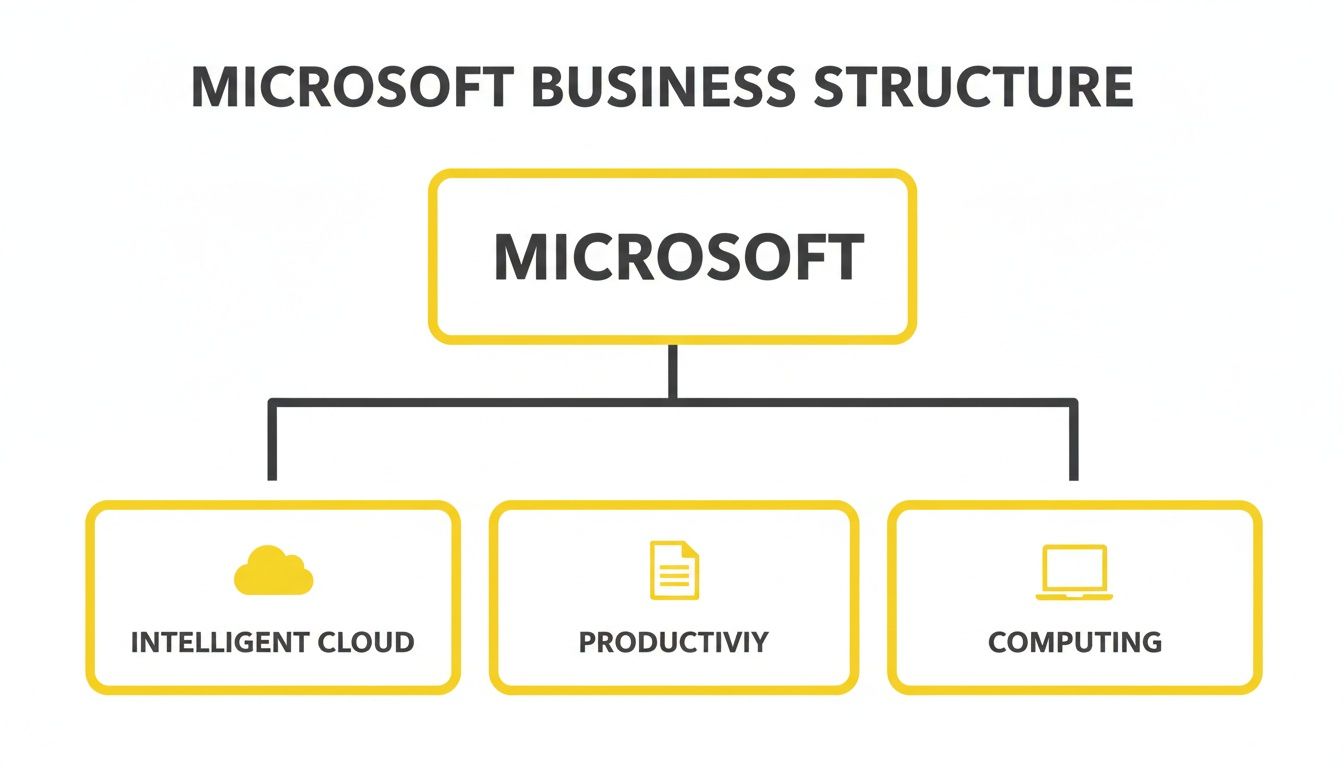
While the company has three core pillars, the AI revolution, led by the OpenAI partnership, is the force multiplier lifting all of them at once.
Fueling the Azure Cloud Engine
The OpenAI deal does more than just make Microsoft's software smarter. It creates a powerful, self-reinforcing cycle that directly benefits Microsoft Azure, its massive cloud computing platform.
It takes an unbelievable amount of computing power to train and run the large AI models that OpenAI builds. As part of their partnership, OpenAI is committed to using Azure exclusively for these incredibly demanding tasks.
This means as the world’s appetite for AI services explodes, so does the demand for Azure's resources. Every single time a business uses a Copilot feature, it’s drawing power from Azure. This direct line between AI adoption and cloud consumption is a huge reason why Wall Street is so bullish on the long-term growth of Microsoft stock. Microsoft isn't just selling the AI software; it's also selling the digital "electricity" needed to power it.
Microsoft's refined agreement with OpenAI solidifies its position, giving it extended IP rights and ensuring OpenAI remains its frontier model partner. This deep integration means as OpenAI's models become more powerful, Azure's value proposition as the premier cloud for AI development becomes even stronger.
This creates a massive competitive moat. While rivals are busy building their own AI models from scratch, Microsoft has a huge head start with a best-in-class partner already plugged into its unparalleled distribution network. For those interested in how this technology is changing the investment world, our guide on how to use AI for stock trading provides some great insights.
This unique strategic position is a key reason many investors are willing to pay a premium for MSFT shares today. The bet is that this AI-fueled growth cycle is just getting started.
Even a giant like Microsoft isn't immune to the market's ups and downs. Watching the MSFT stock price take a hit can be unnerving, but it’s a standard part of the investing game. The real skill is figuring out why it's moving so you can make smart decisions instead of reactive ones.
Short-term price swings often have nothing to do with how Microsoft is actually doing. They're usually tied to bigger economic trends. Think of Microsoft as a solid, well-built ship; sometimes, it gets tossed around by a storm that affects the entire ocean. Things like interest rate hikes, inflation news, or global political tension can trigger widespread selling, dragging down top-tier stocks like MSFT in the process.
Answering Why Is Microsoft Stock Down
When you see the stock dip and ask, "Why is Microsoft stock down?" the reason typically falls into one of two buckets: broad market fear or a company-specific problem. Knowing the difference is everything. A market-wide panic might just be a great buying opportunity, whereas a problem with the company itself could be a red flag.
More often than not, it's the broader market mood that's to blame. For example, if the Federal Reserve hints that interest rates will stay high to fight inflation, it makes money more expensive for everyone. That can ding the future value of a company's earnings, causing a ripple effect across the entire tech sector. In that scenario, the microsoft stock price can fall even when the company itself is firing on all cylinders. You can learn more about market volatility to get a better handle on these forces.
Company-Specific Headwinds to Watch
Of course, it's not always about the wider market. Microsoft has its own unique set of challenges that can give investors pause and put pressure on its stock. The tech world is a battlefield, and Microsoft is fighting on several fronts at once.
- Intense Competition: In the cloud, Azure is in a constant slugfest with Amazon's AWS and Google Cloud. On the AI front, the rivalry with Google is white-hot. If a competitor makes a big move or Microsoft appears to lose a step, it can easily create a short-term dip in microsoft stock.
- Regulatory Scrutiny: Being one of the biggest companies on the planet means you're always under a regulatory microscope. Whether it's in the U.S. or Europe, concerns over antitrust, data privacy, or a major acquisition can create a cloud of uncertainty that spooks some investors.
- Execution Risk: Right now, Wall Street has priced in sky-high expectations for Microsoft, particularly in AI. If the company's AI Copilot features don't roll out smoothly, or if customers are slow to upgrade to the pricier subscription plans, it could lead to disappointing microsoft earnings and a swift stock price correction.
Knowing these risks isn't a reason to run for the hills. It's about being prepared. It allows you to look at a price drop and ask the right question: Is this just market noise, or is it a real crack in Microsoft's long-term story? Answering that is what separates a good investor from the crowd.
How to Actually Buy Microsoft Stock: A Practical Guide
Alright, so you’ve done the reading and now you’re thinking about pulling the trigger. Moving from analysis to action is a big step, but it doesn't have to be complicated. If you're serious about adding Microsoft stock to your portfolio, let's walk through how to do it right. A good investment always starts with good research and a clear plan.
Before you even think about clicking the "buy" button, you need to do your own homework. Never, ever invest based on a hot tip or a flashy headline. The best place to get your facts straight is directly from the source.
- Microsoft's Investor Relations Website: This is your ground zero for official information. You'll find everything from quarterly earnings reports (Form 10-Q) and comprehensive annual reports (Form 10-K) to the transcripts of their calls with Wall Street analysts.
- Trusted Financial News: Keep an eye on reputable sources like The Wall Street Journal, Bloomberg, and Reuters. They provide professional, real-time analysis that can shed light on moves in the MSFT stock price.
- Your Brokerage's Research Tools: Most big brokerage platforms offer their clients a treasure trove of research, including detailed analyst reports and valuation tools for stocks like MSFT.
Once you feel confident in your research, it's time to make the purchase. The whole process is pretty straightforward and happens right inside your brokerage account.
To get your shares, you have to place an order. For most people, it boils down to two main types:
| Order Type | What It Does | When to Use It |
|---|---|---|
| Market Order | Buys the stock for you instantly at whatever the current market price is. You're guaranteed to get the shares, but not the exact price. | You want to get into the stock right away and aren't too worried about small price swings. |
| Limit Order | Lets you set the maximum price you're willing to pay. The order will only go through if the stock hits your price or a better one. | You have a specific entry price in mind and are willing to wait for it. |
Playing the Long Game: How to Build a Position
For most of us, buying Microsoft stock isn't about a quick flip; it's about owning a piece of a world-class company for the long haul. One of the simplest and most effective ways to do this is through a strategy called dollar-cost averaging (DCA).
Dollar-cost averaging just means you invest a set amount of money on a regular schedule—say, $200 worth of MSFT stock on the first of every month—no matter what the stock price is doing.
This simple discipline works wonders over time by smoothing out the bumps. When the stock price is high, your $200 buys you fewer shares. But when the price dips, that same $200 buys you more shares.
This naturally lowers your average cost per share and takes a lot of the guesswork and emotion out of investing. It’s a fantastic way to build a significant position patiently without trying to perfectly time the market.
Frequently Asked Questions (FAQ) about Microsoft Stock
1. Is Microsoft Stock a good long-term investment?
For many, Microsoft is considered a cornerstone long-term investment due to its strong market position in cloud (Azure) and enterprise software, its consistent profitability, and its leadership role in the AI revolution. However, its high valuation means investors are paying a premium for that quality. It depends on an individual's risk tolerance and investment goals.
2. How does Microsoft's partnership with OpenAI affect MSFT stock?
The OpenAI partnership is a primary driver of the MSFT stock price. It allows Microsoft to embed advanced AI ("Copilot") into its entire product suite (Office, Windows, etc.), creating new, high-margin revenue streams. It also drives massive demand for its Azure cloud services, as OpenAI's models run on Azure, creating a powerful growth cycle.
3. Why is Microsoft stock down today?
A drop in MSFT stock can be caused by broad market trends (like inflation or interest rate fears) or company-specific issues (like regulatory concerns, increased competition, or an earnings report that misses expectations). It's crucial to identify the cause to determine if it's a short-term dip or a sign of a deeper issue.
4. What are Microsoft's main sources of revenue?
Microsoft's revenue is primarily driven by three segments: Intelligent Cloud (led by Azure), Productivity and Business Processes (Microsoft 365, LinkedIn, Dynamics 365), and More Personal Computing (Windows, Xbox, Surface). The Intelligent Cloud is currently its largest and fastest-growing segment.
5. What were the key takeaways from the latest Microsoft earnings report?
The latest MSFT earnings reports have consistently highlighted strong, double-digit growth in the Intelligent Cloud segment, driven by high demand for Azure and AI services. Investors closely watch the Azure growth rate and the adoption of AI-powered Copilot subscriptions as key indicators of the company's health and future trajectory.
6. Does Microsoft (MSFT) pay a dividend?
Yes, Microsoft pays a quarterly dividend and has a strong track record of consistently increasing it over time. This makes MSFT stock attractive to both growth investors and those seeking income.
7. Who are Microsoft's biggest competitors?
Microsoft competes on multiple fronts. In cloud computing, its main rivals are Amazon (AWS) and Google (GCP). In AI, it competes fiercely with Google. In business applications, it faces companies like Salesforce and Oracle. In gaming, its primary competitor is Sony (PlayStation).
8. Is the current Microsoft stock price overvalued?
Valuation is subjective. MSFT's P/E ratio is often higher than the broader market average, indicating that investors have high growth expectations priced in, largely due to its AI leadership. Whether it's "overvalued" depends on whether you believe the company can deliver on that expected growth.
9. What impact does the gaming division (Xbox) have on the stock?
The gaming division is a significant part of the "More Personal Computing" segment. With the acquisition of Activision Blizzard, Microsoft is now a gaming titan. The success of Xbox consoles, Game Pass subscriptions, and major game titles contributes billions in revenue and strengthens Microsoft's position in the consumer entertainment market.
10. Where can I find the most reliable information on MSFT earnings and news?
The most accurate source for financial filings is Microsoft's Investor Relations website, which contains official SEC filings (10-K and 10-Q). For ongoing news and analysis, reputable financial news outlets like Bloomberg, The Wall Street Journal, and Reuters are excellent resources.
This article is for educational purposes only and is not financial or investment advice. Consult a professional before making financial decisions
At Top Wealth Guide, we provide the insights and strategies you need to build and manage your wealth effectively. Explore our resources to navigate the complexities of financial markets and achieve your investment goals. Learn more at https://topwealthguide.com.
