

Think of disability insurance as your personal financial backup plan. It's designed to step in and replace a chunk of your income if you're hit with an illness or injury that keeps you from working. It’s the ultimate defense for what is, without a doubt, your single most valuable asset: your ability to earn a living. This coverage makes sure you can still pay the bills even when your paycheck stops coming.
In This Guide
- 1 Why Your Income Is Your Most Powerful Wealth-Building Tool
- 2 Decoding the Different Types of Disability Insurance
- 3 Cracking the Code: How Your Policy Costs and Benefits Are Calculated
- 4 Customizing Your Policy with Essential Riders
- 5 Integrating Disability Insurance Into Your Wealth Strategy
- 6 Navigating the Disability Claim Process Successfully
- 7 Frequently Asked Questions (FAQ)
- 7.1 1. How much disability insurance coverage do I really need?
- 7.2 2. Is the group plan I have through work good enough?
- 7.3 3. I'm self-employed. Can I get a disability insurance policy?
- 7.4 4. What's the underwriting process actually like?
- 7.5 5. Are my disability insurance premiums tax-deductible?
- 7.6 6. How do pre-existing conditions affect my coverage?
- 7.7 7. When's the best time to buy disability insurance?
- 7.8 8. What happens if I change jobs?
- 7.9 9. What is an "elimination period"?
- 7.10 10. How do I choose a good insurance company?
- 8 This article is for educational purposes only and is not financial or investment advice. Consult a professional before making financial decisions
Why Your Income Is Your Most Powerful Wealth-Building Tool
Let's imagine your financial plan is a high-performance engine you've built to grow your wealth. Your stocks, real estate, and retirement funds are all essential parts, but your income is the high-octane fuel that makes the whole thing go. If that fuel supply gets cut off, the engine sputters and stalls out.
It's common for self-employed professionals and investors to get hyper-focused on accumulating assets. They're all about growing their portfolio or business. But they often forget to protect the very source of cash that makes all that growth possible in the first place.
The Danger of Draining Your Nest Egg
Trying to get by on your savings or investment portfolio during a long-term disability is a massive gamble. A serious illness or a bad accident could force you to start selling off assets you had earmarked for retirement, your kids' education, or other big goals.
Real-Life Example: Mark, a 42-year-old architect, suffered a debilitating back injury in a car accident. He was unable to work for 18 months. Without disability insurance, he would have been forced to sell stocks from his retirement portfolio to cover his $7,000 monthly living expenses. Not only would this have triggered capital gains taxes, but it also would have pulled that money out of the market, causing him to miss a significant market recovery. His disability policy provided a tax-free monthly income, leaving his nest egg completely untouched to continue growing.
This is exactly where a solid disability insurance policy acts like a financial firewall. It protects the wealth you’ve already built by giving you a separate, reliable stream of income when you can't work. It ensures your financial engine never runs out of fuel.
A well-designed policy keeps your entire financial strategy moving forward. It lets your investments keep compounding and prevents a temporary health problem from turning into a permanent financial disaster. Really, it’s not just another bill to pay; it’s an investment in keeping your entire wealth-building journey on track. To really get why this is so important, it helps to see how consistent earnings build your net worth. You can learn more about why cash flow management is crucial for wealth building and see how disability insurance protects that flow.
Decoding the Different Types of Disability Insurance
When you start digging into disability insurance, you quickly realize it’s not a one-size-fits-all product. Think of it less like buying a standard product off the shelf and more like getting a custom suit tailored to your career, income, and financial life. The right policy for a surgeon is going to look very different from the right one for a freelance graphic designer.
The world of disability insurance really boils down to a few key distinctions that determine when, how, and for how long you get paid if you can't work. Nailing down these differences is the most important step in making sure your income is truly protected.
At the highest level, coverage is split into two main buckets: Short-Term Disability and Long-Term Disability. Each is built for a totally different kind of work interruption.
This is where disability insurance acts as a financial shield, protecting your most valuable asset—your ability to earn an income—so you can stay on track with your long-term goals, no matter what life throws at you.
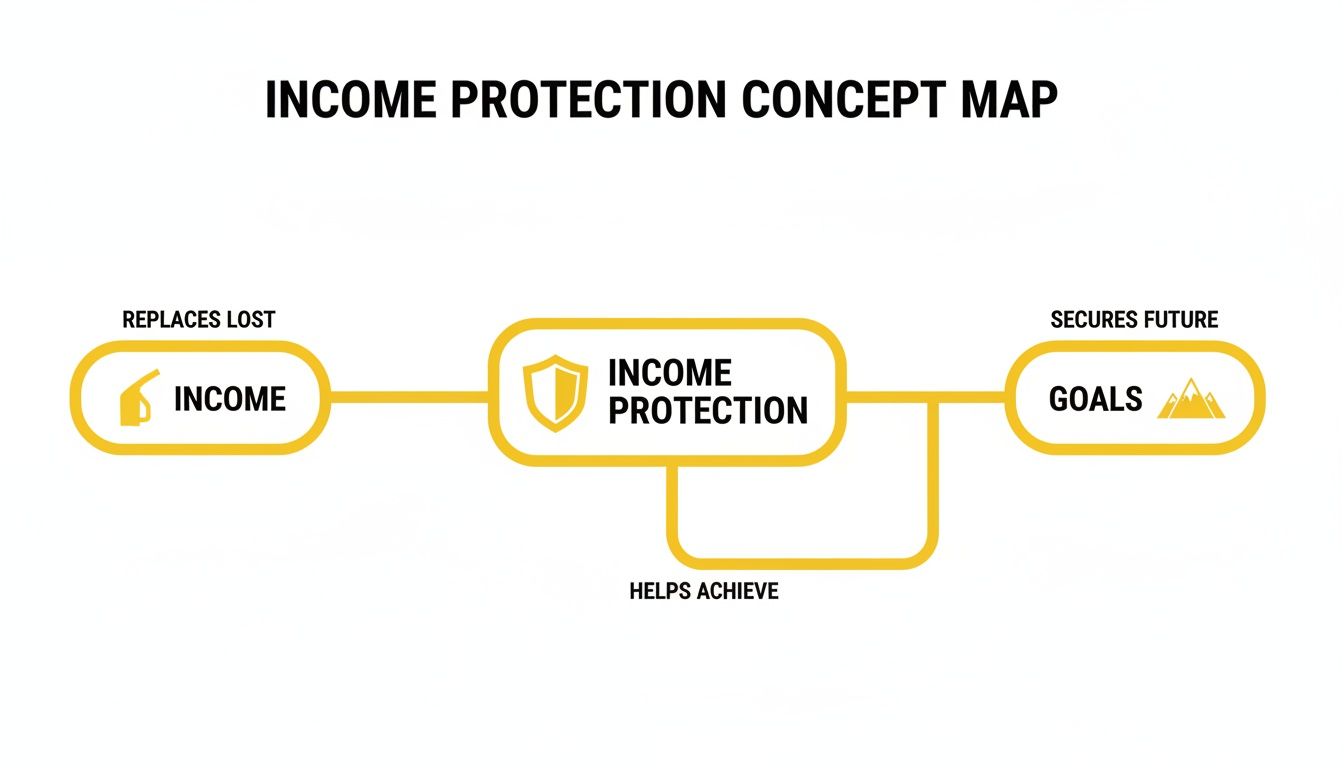
As you can see, the policy keeps the financial engine running, even when your primary fuel source (your paycheck) is temporarily cut off.
Short-Term vs. Long-Term Disability Insurance
Short-Term Disability (STD) insurance is your safety net for those temporary bumps in the road. We're talking about a few weeks or months off work to recover from a surgery, a complicated pregnancy, or a serious illness. STD policies have a brief waiting period, often just 7 to 14 days, before benefits kick in. They typically pay out for a defined period, like three to six months, and are often a standard part of an employee benefits package.
Long-Term Disability (LTD) insurance, on the other hand, is built for the big stuff—the serious, potentially career-changing events. This is the coverage that protects your income for years, sometimes all the way to retirement age. The waiting period here is much longer, usually 90 days or more, and it’s designed to pick up right where your short-term benefits leave off. The two policies are meant to work hand-in-glove, creating a seamless financial bridge.
This isn't a niche market, either. Recent industry data shows U.S. insurers have $19.9 billion in premiums on the books, with the average long-term policy costing $292.3 per person annually and short-term averaging $224.7. It's a huge part of the financial protection landscape.
Short-Term vs Long-Term Disability Insurance At a Glance
Here’s a quick side-by-side look to help you see how these two types of coverage fit together.
| Feature | Short-Term Disability (STD) | Long-Term Disability (LTD) |
|---|---|---|
| Purpose | Covers temporary illnesses or injuries. | Covers prolonged, career-impacting disabilities. |
| Elimination Period | Typically 1 to 14 days. | Usually 90 days or longer. |
| Benefit Period | 3 to 6 months is common. | Can last for years, often until age 65 or 67. |
| Typical Source | Often provided by an employer. | Often an individual policy or employer group plan. |
| Coverage Amount | Often 60-70% of gross income. | Typically 60% of gross income. |
Think of STD as the immediate first aid, while LTD is the long-term care plan. You really need both for a complete safety net.
The Most Important Clause: Own-Occupation vs. Any-Occupation
Now, let's get to what I consider the single most critical detail in any disability policy: the definition of "disability." This isn't just fine print; this clause is the heart of your contract. It dictates the exact circumstances under which the insurance company has to pay your claim. The two definitions you absolutely must know are Own-Occupation and Any-Occupation.
An Own-Occupation policy is the gold standard, especially for people in specialized careers. It defines disability as being unable to perform the main duties of your specific job. It protects the skills you've spent years, and often a lot of money, developing.
Here’s a real-world example: Imagine a cardiac surgeon who develops a slight hand tremor. She can no longer perform delicate heart surgeries, but she's perfectly capable of teaching at a medical school or working as a hospital administrator. With a true Own-Occupation policy, she’d be considered disabled and could collect her full benefit—because she can't do her job.
An Any-Occupation policy is a whole different ballgame—and a much tougher one for you to win. It defines disability as being unable to work in any job for which you're reasonably suited based on your education, experience, and training. That same surgeon? An Any-Occupation policy would almost certainly deny her claim because she can still earn a good living in other roles.
If you're a professional, an entrepreneur, or anyone with a specialized, high-earning career, you absolutely want an Own-Occupation policy. It’s the only way to truly protect the investment you’ve made in yourself.
Of course, protecting your income is just one piece of a solid financial plan. Securing your largest assets, like your home, is just as crucial. You might find our guide on how mortgage protection insurance works helpful as you build out your complete asset protection strategy.
Cracking the Code: How Your Policy Costs and Benefits Are Calculated
Figuring out the numbers behind a disability insurance policy can feel like you're trying to solve a complex puzzle. But it's actually much more straightforward once you understand two key pieces: how much money you’d get (your benefit) and what you’ll pay for it (your premium).
Let’s start with the benefit. Insurers will typically let you cover about 60-70% of your gross income. This isn't a random number; it’s a long-standing industry practice. The goal is to give you a meaningful income replacement without creating a situation where it's more profitable to stay home than to get back to work. It keeps the whole system in balance.
Ultimately, this monthly benefit is the whole point of the policy—it's the paycheck you'll depend on if an injury or illness keeps you from earning one yourself.

Key Factors That Determine Your Premiums
Now, what about the cost? Think of it like auto insurance. Insuring a teenager with a new sports car is going to cost a lot more than insuring a 40-year-old with a minivan and a perfect driving record. The same principle applies here: higher risk means a higher premium.
Underwriters look at several key factors to figure out your specific price tag:
- Your Age and Health: This one's simple. Younger, healthier people pay less. It's why getting a policy early in your career is one of the smartest things you can do for your financial future.
- Your Occupation: A roofer who spends their days on ladders faces a lot more physical risk than a graphic designer working from a home office. Insurers group jobs into risk classes, and this classification has a huge impact on your rate.
- Your Income: The more you earn, the bigger the potential benefit an insurer would have to pay. Because their potential payout is higher, the premium for a high-earner's policy will naturally be higher too.
- Benefit Period: This is how long the policy will pay out if you need it. A plan that covers you all the way to age 67 is going to cost more than one that stops paying after five years.
- Elimination Period: You can think of this as your policy's "deductible," but measured in time. It's the waiting period between when you become disabled and when your benefits kick in. Choosing a longer period, like 90 or 180 days, will lower your premium because you're agreeing to cover the first few months yourself. This is where a solid emergency fund becomes your best friend. To check if your savings are up to the task, it’s worth learning how to build an emergency fund that can bridge that gap.
A Tale of Two Professionals: Premium Comparison
To really see how this all comes together, let’s look at a couple of real-world examples. This helps turn these abstract ideas into concrete numbers. Here’s a breakdown of how an underwriter might price policies for two very different self-employed individuals:
| Factor | Profile A: Graphic Designer | Profile B: Construction Manager |
|---|---|---|
| Age | 35 | 50 |
| Occupation Risk | Low (Office-based, low physical risk) | High (On-site, high physical risk) |
| Annual Income | $90,000 | $150,000 |
| Requested Benefit | $4,500/month (60% of income) | $7,500/month (60% of income) |
| Benefit Period | To Age 67 | To Age 67 |
| Elimination Period | 90 Days | 90 Days |
| Health Status | Excellent, non-smoker | Good, non-smoker, minor pre-existing condition (controlled high blood pressure) |
| Estimated Premium | $100 – $150 per month | $350 – $500 per month |
As you can see, the construction manager’s older age, riskier job, higher income, and even a minor health issue all add up. The result is a significantly higher premium compared to the younger graphic designer in a low-risk profession. Each factor gets weighed and measured to create a final price that accurately matches the insurer's risk.
Customizing Your Policy with Essential Riders
Think of your disability insurance policy as the chassis of a new car. It’s solid and provides the essential protection you need, but it's the optional features—the sunroof, the premium sound system, the advanced safety package—that truly make it yours. In the insurance world, these upgrades are called riders.
Riders are simply optional provisions you can add to your base policy to plug specific gaps and beef up your coverage. They aren't just confusing add-ons meant to jack up your premium; they are strategic tools that let you build a policy that fits your life and career trajectory perfectly. Choosing the right ones transforms a generic policy into a personalized financial shield.

The Most Common and Valuable Disability Riders
While you might see dozens of rider options, only a handful are truly essential for most professionals and self-employed individuals. Let's cut through the noise and focus on the ones that deliver the most bang for your buck.
-
Cost-of-Living Adjustment (COLA) Rider: This is your inflation shield. A $5,000 monthly benefit sounds great today, but what will that money buy in 10 or 20 years? A COLA rider automatically increases your monthly benefit each year you're on a claim, making sure your income keeps pace with the rising cost of everything else.
-
Residual or Partial Disability Rider: This might be the single most important rider for high-earners. A disability often isn't an on/off switch. This rider pays a portion of your benefit if you can still work, but not at full capacity, leading to an income loss (usually 15-20% or more). It’s a financial bridge when you're not totally disabled but still taking a significant financial hit.
Real-Life Example: A management consultant suffers a back injury. She can’t handle the grueling travel schedule anymore but can manage 15 hours a week working from home. Without this rider, she might get nothing. With it, she receives a partial benefit to help close the gap between her old six-figure salary and her new, reduced income.
- Future Increase Option (FIO) Rider: This one is a must-have for young professionals on the upswing. The FIO rider gives you the right to buy more coverage later on without going through another medical exam. As your income grows, this rider guarantees you can increase your protection to match, even if you've developed health issues that would otherwise make you uninsurable.
Comparing Key Policy Upgrades
So, how do you decide which ones are non-negotiable? This simple breakdown shows what each rider is designed to do.
| Rider Name | Primary Benefit | Who Needs It Most? |
|---|---|---|
| COLA Rider | Protects your benefit's buying power from inflation during a long-term claim. | Anyone with a long benefit period (e.g., to age 65 or 67). |
| Residual Rider | Pays partial benefits if you can work part-time but earn less due to your disability. | High-income professionals, business owners, and anyone with a variable income. |
| FIO Rider | Guarantees you can increase coverage as your income grows, with no new medical exam. | Medical residents, new lawyers, entrepreneurs—anyone expecting their income to rise. |
Picking the right riders is a crucial step in building a truly robust financial safety net. While disability insurance is all about protecting your income stream, other policies focus on protecting your legacy. To get a handle on that piece of the puzzle, check out our guide comparing whole life vs term life insurance, which breaks down how to best provide for your loved ones.
Integrating Disability Insurance Into Your Wealth Strategy
Think of your financial plan as a well-oiled machine. Each part—your investments, savings, retirement accounts—has a specific job. But what powers the whole thing? Your ability to earn an income. Disability insurance isn't just another product you buy; it's the master fuse that protects the entire system from shutting down.
Without it, a sudden illness or injury could force you to start pulling that machine apart piece by piece. You might have to liquidate investments at the worst possible time, perhaps during a market dip, or raid your retirement accounts and get hit with hefty taxes and penalties. Suddenly, the wealth you spent years building starts to unravel.
The Tax-Free Advantage You Can’t Ignore
One of the most compelling features of a private disability policy, and one that many people miss, is how the benefits are taxed. When you pay the premiums yourself with your after-tax dollars, every penny you receive in benefits comes to you completely tax-free. This is a huge deal.
Let's say you make $150,000 a year and your policy is set up to replace 60% of that. You'd get a $90,000 annual benefit. If that were taxable income, you might only end up with $65,000 or $70,000 in your pocket after the IRS takes its share. But because it’s tax-free, you get the full $90,000. That certainty can make all the difference when you're navigating a difficult time.
For more ideas on how to secure your finances, our guide on wealth protection strategies during economic downturns offers some great insights.
Why You Can’t Just Rely On Government Programs
A common mistake is assuming that government safety nets like Social Security Disability Insurance (SSDI) will be enough. While SSDI is a crucial program, for anyone serious about building wealth, leaning on it as your only plan is a massive gamble.
Here's a reality check on why a private policy is so important:
- The Definition is Extremely Strict: To get SSDI, you have to prove you can't do any meaningful work, not just the job you were trained for. It's a very high bar to clear.
- Most People Get Denied: The initial application denial rate for SSDI is notoriously high, often over 60%. The appeals process can be a draining, frustrating journey that drags on for months, or even years.
- The Payouts are Modest: SSDI benefits are designed to provide a basic floor, not to maintain your current lifestyle or keep your investment plan on track.
Think of a private policy as your first line of defense. It's designed to protect your career and your income, letting you keep your financial goals moving forward while government benefits serve as a potential backup.
Protecting Your Portfolio and Your Future
At its core, disability insurance is one of the purest forms of asset protection you can buy. It builds a firewall around your retirement funds, investment portfolios, and real estate, preventing you from having to sell them off just to pay the bills. It’s the buffer that keeps your long-term plan intact when life throws you a curveball.
It’s no surprise that the global market for this kind of protection is growing, with some analysts projecting it will hit $17.07 billion by 2035. More and more people are realizing it's an essential piece of a solid financial foundation. You can read more on this trend in a detailed market report on marketresearchfuture.com.
Here's How It Works in Real Life: Sarah is a 45-year-old self-employed architect. A serious back injury means she can no longer handle the long hours at a drafting table or make on-site visits. Her own-occupation disability policy starts paying her $8,000 tax-free every month. This income keeps her afloat—covering her mortgage and daily expenses—without her having to touch the $1.2 million investment portfolio she's built for retirement. Without that policy, she’d be forced to start selling off those assets, putting her entire financial future at risk.
An insurance policy is nothing more than a promise on paper until the day you actually need it. Its real value only comes to light when you have to file a claim, and navigating that process during an already stressful time can be a huge challenge.
The claims process isn't meant to be a fight, but it is incredibly thorough. Insurers have a duty to verify your disability, confirm your income, and make sure every condition in your policy has been met. Your best defense is a good offense—being organized from day one is the key to getting your benefits paid smoothly and on time.
A Step-by-Step Guide to Filing Your Claim
Think of the claims process like a series of checkpoints. Missing even one can cause serious delays, so it pays to know the roadmap.
-
Notify Your Insurer Immediately: As soon as you realize your disability will likely last beyond your policy's waiting period, contact your insurance company. Don't put it off. Most policies have strict deadlines for how soon you need to report a potential claim.
-
Complete the Claim Forms: The insurer will send you a claims packet, which usually includes a claimant statement (your side of the story), an employer statement (to confirm your job duties and income), and an attending physician’s statement (the crucial medical evidence).
-
Gather Comprehensive Documentation: This is where claims are won or lost. The insurer needs objective medical proof that supports your disability. We're talking doctor’s notes, MRI results, lab work, and a clear explanation of exactly how your condition stops you from doing your job.
Common Pitfalls and How to Avoid Them
Even with a completely legitimate disability, simple mistakes can lead to frustrating delays or even an outright denial. Knowing where the landmines are is the best way to avoid them.
The single biggest mistake claimants make is providing incomplete or inconsistent information. Your story has to match what's in your medical records. If you tell the insurer you can't sit for more than 10 minutes, but your doctor’s notes from last week say you're "showing great improvement," that's a red flag they will absolutely investigate.
Another classic pitfall is simply missing deadlines. Insurance companies run on tight schedules. If they ask for more information, get it to them quickly. Dragging your feet can be seen as not cooperating, and they might just close your claim file.
Real-Life Scenario: A self-employed graphic designer filed a claim for a severe back injury. He sent in his initial MRI report but didn't provide records of the ongoing physical therapy his doctor prescribed. The insurance company initially denied the claim for "lack of continuing medical care." It was only after he submitted all his physical therapy notes—proving he was actively trying to get better—that they reversed the decision and approved his benefits.
A Comparison of Common Claim Delays
Understanding why claims get held up can help you stay one step ahead. Here are the usual suspects when it comes to delays and how you can get in front of them.
| Reason for Delay | How to Proactively Address It |
|---|---|
| Insufficient Medical Records | Ask your doctor to be specific in their notes. Instead of "patient has back pain," they should write "patient is unable to sit for more than 20 minutes due to herniated disc L4-L5, preventing desk work." |
| Vague Job Description | Don't just say you're a "consultant." Give the insurer a detailed breakdown of your daily tasks, highlighting the ones you can no longer do because of your condition. |
| Missed Deadlines | Keep a dedicated file for all claim paperwork—digital or physical. Set calendar reminders for any deadlines the insurer gives you. |
| Inconsistent Information | Before you submit anything, double-check that the information on your forms aligns perfectly with what's in your medical records and what your employer is reporting. |
At the end of the day, a successful claim boils down to clear communication, meticulous record-keeping, and a cooperative attitude. If you treat the process with the seriousness it deserves, you can make sure your disability policy delivers on its promise right when you need it most.
Frequently Asked Questions (FAQ)
1. How much disability insurance coverage do I really need?
The general rule is to cover 60-70% of your gross income. However, the most accurate way is to calculate your essential monthly expenses (mortgage, utilities, food, insurance premiums) and ensure your benefit amount comfortably covers these non-negotiable costs.
2. Is the group plan I have through work good enough?
While a good starting point, a group plan is often insufficient. Benefits are typically taxable (reducing your net payout), the definition of disability may be a restrictive "any-occupation" clause, and the coverage may be capped well below your actual income. A private "own-occupation" policy provides more comprehensive and portable protection.
3. I'm self-employed. Can I get a disability insurance policy?
Yes, and it's arguably more critical for you. Since you lack an employer-provided safety net, a personal disability policy is essential. Insurers will typically ask for two to three years of tax returns to verify your income and determine the benefit amount you qualify for.
4. What's the underwriting process actually like?
Underwriting is how the insurer assesses your risk. It involves a detailed application covering your health, occupation, income, and lifestyle. A medical exam (similar to a routine physical) and a review of your medical records are standard. Complete honesty is crucial; omitting information can lead to a denied claim later.
For a personal policy paid with after-tax money, the premiums are not tax-deductible. The significant advantage is that any benefits you receive are 100% tax-free. If an employer pays the premiums, they get the deduction, but the benefits you receive are considered taxable income.
6. How do pre-existing conditions affect my coverage?
It depends on the specific condition. An insurer might add an "exclusion rider" for that condition, meaning it won't be covered. Alternatively, they might offer coverage after a certain waiting period with no symptoms. Disclosing all conditions upfront is the best way to ensure your policy is secure.
7. When's the best time to buy disability insurance?
As soon as possible. Buying a policy when you are young and healthy locks in the lowest possible rates for your entire career. Waiting until you are older or develop a health condition can make coverage significantly more expensive or even unobtainable.
8. What happens if I change jobs?
A personal disability insurance policy is 100% portable. It is a contract between you and the insurance company, so it follows you wherever your career takes you, whether you switch employers, move states, or become self-employed.
9. What is an "elimination period"?
The elimination period is the waiting period between the date you become disabled and the date your benefits begin. Think of it as a time-based deductible. Common options are 30, 60, 90, or 180 days. Choosing a longer period lowers your premium but requires a larger emergency fund to cover expenses during the wait.
10. How do I choose a good insurance company?
Look for a company with strong, long-term financial health. Check for high ratings from independent agencies like A.M. Best, where an A+ or A++ rating indicates superior financial stability. Also, consider the company's reputation for customer service and claims payment history.
This article is for educational purposes only and is not financial or investment advice. Consult a professional before making financial decisions
At Top Wealth Guide, our mission is to provide you with the insights and strategies needed to build and protect your financial future. Whether you're just starting or are an experienced investor, we have the resources to help you reach your goals. Explore more wealth-building strategies on Top Wealth Guide and take control of your financial journey.
