

The concept of "passive income" often brings to mind images of earning money while you sleep, a financial stream that flows without constant, active effort. While this ideal is achievable, it's crucial to understand that passive income isn't "free money." It is the result of a significant upfront investment, either of time, money, or both. The goal is to build an asset that, once established, generates revenue with minimal ongoing maintenance. This frees you from the traditional trade of time for money, creating financial resilience and opening up opportunities for greater freedom.
This guide is designed to move beyond abstract theories and provide a comprehensive, actionable blueprint for building these income streams. We will dissect some of the best passive income ideas, offering a clear-eyed look at what it truly takes to succeed. For each strategy, we will detail the required startup capital and time commitment, analyze the potential risk level, and provide realistic estimates for returns. You won't find vague advice here. Instead, you'll get step-by-step starter actions, essential tools and resources, critical tax and legal considerations, and guidance on which ideas best fit your personal skills, risk tolerance, and financial goals.
Whether you're an investor looking to diversify your portfolio, a creator ready to monetize your skills, or a beginner seeking your first step toward financial independence, this article provides the practical framework you need. We'll explore everything from dividend investing and real estate to creating digital products and leveraging affiliate marketing, equipping you with the knowledge to select and implement the right passive income strategy for your future.
In This Guide
- 1 1. Dividend Investing
- 2 2. Rental Properties & Real Estate
- 3 3. High-Yield Savings Accounts & CDs
- 4 4. Digital Products & Online Courses
- 5 5. Content Creation & Ad Revenue (YouTube, Blogs, Podcasts)
- 6 6. Affiliate Marketing
- 7 7. Peer-to-Peer Lending & Crowdfunding
- 8 8. Automated E-Commerce & Print-on-Demand
- 9 9. License Your Creations (Photos, Music, Designs)
- 10 10. Automated Dropshipping & E-Commerce Stores
- 11 Top 10 Passive Income Ideas — Quick Comparison
- 12 Final Thoughts
- 13 Frequently Asked Questions (FAQ)
- 13.1 1. What is a realistic passive income goal for a beginner?
- 13.2 2. Which passive income idea requires the least amount of money to start?
- 13.3 3. Can passive income be truly 100% passive?
- 13.4 4. How are passive income streams taxed?
- 13.5 5. What is the biggest mistake people make when pursuing passive income?
- 13.6 6. Is it better to focus on one passive income stream or build several at once?
- 13.7 7. Which passive income idea has the highest potential return?
- 13.8 8. How can I earn passive income if I have no special skills?
- 13.9 9. What is the difference between passive income and a side hustle?
- 13.10 10. Are high-yield savings accounts a good passive income strategy with inflation?
1. Dividend Investing
Dividend investing is a time-tested strategy for generating passive income. It involves buying stocks or funds that distribute a portion of their profits to shareholders, known as dividends. These payments, typically made quarterly, provide a regular income stream while your initial investment has the potential to grow in value. This makes it one of the best passive income ideas for long-term wealth creation.
This approach essentially lets you own a piece of a profitable company and share in its success without active involvement. You get paid simply for holding the investment.
How Dividend Investing Works
When a company like Coca-Cola or Procter & Gamble earns a profit, its board of directors may decide to return some of that money to its investors. By owning shares, you receive a specific cash payment per share. For example, if you own 100 shares of a company that pays a $0.50 quarterly dividend, you'll receive $50 every three months.
The real power comes from compounding. By reinvesting these dividends to buy more shares, often through a Dividend Reinvestment Plan (DRIP), your future dividend payments increase, creating a snowball effect over time.
Real-Life Example: Sarah, a 30-year-old marketing manager, started by investing $500 per month into a low-cost dividend ETF like the Schwab U.S. Dividend Equity ETF™ (SCHD). She also enrolled in its DRIP. After 10 years, her initial investment of $60,000 has grown significantly, not just from market appreciation but also from the reinvested dividends buying more shares. She now earns over $2,000 annually in passive dividend income, which continues to grow without any additional effort.
Getting Started with Dividend Investing
- Open a Brokerage Account: You'll need an account with a platform like Fidelity, Vanguard, or Charles Schwab.
- Choose Your Investments:
- Dividend ETFs: For beginners, an ETF like the Vanguard Dividend Appreciation ETF (VIG) offers instant diversification across hundreds of dividend-paying companies.
- Dividend Aristocrats: Focus on companies with a long history of increasing their dividends, like Johnson & Johnson. These are stocks in the S&P 500 that have raised their dividend for 25+ consecutive years.
- Automate and Reinvest: Set up automatic monthly investments to practice dollar-cost averaging. Crucially, enroll in a DRIP to automatically reinvest your dividends, maximizing the power of compounding.
Key Insight: The goal isn't just to find the highest dividend yield, which can be a red flag for a struggling company. Focus on quality companies with a sustainable history of dividend growth, as this indicates financial health and a commitment to rewarding shareholders.
2. Rental Properties & Real Estate
Investing in rental properties is a classic, tangible method for building wealth and generating passive income. This strategy involves purchasing residential or commercial real estate and leasing it to tenants for a monthly fee. This provides a steady cash flow while the property itself can appreciate in value over time, making it one of the most powerful passive income ideas available.
This approach allows you to build an asset that pays you, leveraging other people's money (through a mortgage) to create a substantial income stream. While it can require more upfront capital than other methods, its returns and stability are hard to match.
How Rental Properties & Real Estate Works
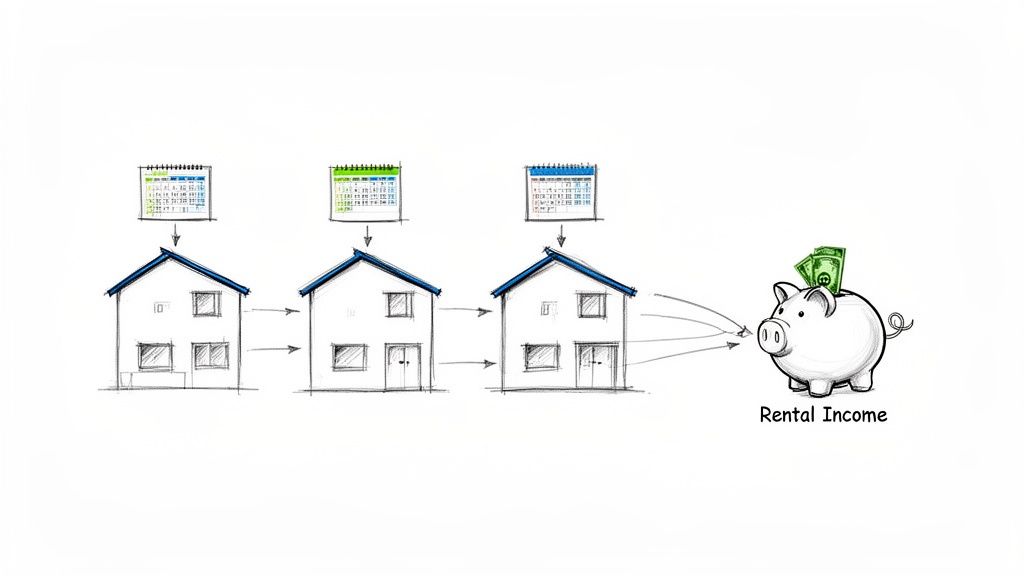
The concept is straightforward: you own a property, and a tenant pays you rent to live in or use it. After covering expenses like the mortgage, insurance, property taxes, and maintenance, the remaining money is your profit, or cash flow. For instance, if your single-family rental brings in $2,000 in rent and your total expenses are $1,500, you generate $500 in passive income each month.
The real wealth-building comes from four key areas: monthly cash flow, property appreciation, loan paydown by tenants, and significant tax advantages. Over time, your tenants are effectively buying the asset for you while its value grows.
Real-Life Example: After saving for a down payment, Mark bought a duplex in a growing Midwest city. He lives in one unit and rents out the other for $1,600 per month. His total mortgage payment is $1,800. The tenant's rent covers most of his housing cost, a strategy known as "house hacking." He also hired a property manager for a small fee to handle tenant issues, making the income largely passive. The monthly cash flow and tax benefits have allowed him to save for his next property.
Getting Started with Rental Properties
- Secure Financing: Get pre-approved for a mortgage to understand your budget. Lenders typically require a down payment of 20-25% for investment properties.
- Find and Analyze a Deal:
- Market Research: Target areas with strong job growth and population increases. Platforms like Zillow and Realtor.com are good starting points.
- Property Analysis: Use a tool like the BiggerPockets Rental Property Calculator to analyze potential deals. Calculate key metrics like cash-on-cash return and capitalization (cap) rate to ensure profitability.
- Manage Your Property: To make the income truly passive, hire a professional property management company. They handle everything from tenant screening and rent collection to maintenance, typically for 8-10% of the monthly rent. This automates the day-to-day operations.
Key Insight: Your profit is made when you buy, not when you sell. Focus on finding a good deal by analyzing numbers rigorously before making an offer. Never let emotion drive a purchase; successful real estate investing is a game of mathematics and due diligence.
3. High-Yield Savings Accounts & CDs
For those prioritizing safety and guaranteed returns, high-yield savings accounts (HYSAs) and certificates of deposit (CDs) are foundational passive income ideas. These are FDIC-insured deposit accounts offered primarily by online banks that pay interest rates significantly higher than those at traditional brick-and-mortar institutions.
This strategy is the digital equivalent of earning interest on your idle cash, but on steroids. Instead of the negligible interest offered by a standard checking account, you earn a competitive return simply for parking your money in a secure place, making it a perfect starting point for passive income.
How HYSAs & CDs Work
A high-yield savings account functions like a regular savings account but with a much better Annual Percentage Yield (APY). You deposit money and earn interest on your balance, with the flexibility to withdraw funds as needed. A Certificate of Deposit offers a fixed, often higher, interest rate in exchange for locking your money up for a specific term, ranging from a few months to several years.
For example, if you deposit $10,000 into an HYSA with a 4.50% APY, you would earn $450 in passive income over a year. With a CD, you lock in that rate for the entire term, protecting you from rate drops.
Real-Life Example: Emily needed a safe place for her $20,000 emergency fund. Instead of leaving it in her checking account earning 0.01%, she moved it to a high-yield savings account at Ally Bank with a 4.25% APY. She now earns approximately $850 per year in interest, completely passively, while her money remains liquid and FDIC-insured. This income helps offset inflation, ensuring her emergency fund maintains its purchasing power.
Getting Started with HYSAs & CDs
- Compare Rates and Open an Account: You'll need to open an account with an online bank. Use a comparison site like Bankrate to find the best current APYs for institutions like Marcus by Goldman Sachs, Ally Bank, or American Express Personal Savings.
- Choose Your Strategy:
- High-Yield Savings Account: Ideal for your emergency fund or short-term savings goals where you need flexibility and access to your cash.
- CD Laddering: For funds you won't need immediately, open multiple CDs with staggered maturity dates (e.g., 3-month, 6-month, 1-year). As each CD matures, you can reinvest it at the current best rate or access the cash, combining higher returns with periodic liquidity.
- Fund and Automate: Transfer your initial deposit and set up automatic monthly transfers from your checking account to consistently grow your interest-earning balance.
Key Insight: While HYSAs and CDs offer lower returns than stocks, their value lies in their absolute safety (up to $250,000 FDIC insurance) and predictability. They are an essential tool for protecting your principal and ensuring your emergency fund is also generating passive income, not losing value to inflation.
4. Digital Products & Online Courses
Creating and selling digital products is a powerful strategy for building passive income. This involves creating a valuable digital asset once, such as an ebook, online course, or software template, and selling it repeatedly with minimal ongoing effort. The initial time investment in creation pays off as sales can occur 24/7, even while you sleep.
This approach transforms your knowledge or skill into a scalable asset. Unlike a service-based business, you aren't trading time for money; you're building a system that generates revenue automatically.

How Digital Products & Online Courses Work
You identify a specific problem or need within a niche you understand, like "helping small businesses with social media." You then create a digital solution, such as a comprehensive online course on Instagram marketing, a set of downloadable Canva templates, or a Notion planner for content creators.
Once created, you list your product on a platform like Gumroad or a course host like Teachable. Customers purchase and receive the product instantly through an automated system. Your main ongoing task shifts from creation to marketing, which itself can be automated through email funnels and content marketing.
Real-Life Example: Daniel, a freelance graphic designer, noticed many of his clients struggled with creating professional-looking presentations. He spent 40 hours creating a premium bundle of 50 customizable PowerPoint and Google Slides templates. He listed it on Gumroad for $49. After an initial marketing push, the template bundle now sells consistently through search and word-of-mouth, generating $800-$1,200 per month in passive income with almost no ongoing work.
Getting Started with Digital Products & Online Courses
- Identify Your Niche and Validate Your Idea: Choose a topic where you have genuine expertise. Before creating anything, validate demand by surveying your audience or creating a small, low-cost "tester" product like a checklist or short ebook.
- Choose Your Product & Platform:
- Online Courses: For in-depth topics, use platforms like Teachable or Thinkific to host your video lessons and materials.
- Ebooks & Templates: For simpler products, marketplaces like Gumroad or Etsy are excellent starting points with built-in audiences.
- Create and Launch: Invest in quality. Use good audio/video equipment for courses and professional design for templates. Build an email list to announce your launch and offer early-bird discounts to generate initial momentum and reviews.
Key Insight: Start small to test the market and build momentum. Instead of launching a massive, 50-hour course, begin with a $29 ebook or a set of templates. This validates your idea, generates initial revenue, and builds a customer base you can sell future, larger products to.
5. Content Creation & Ad Revenue (YouTube, Blogs, Podcasts)
Creating valuable content is one of the most accessible and potentially lucrative passive income ideas available today. This strategy involves building an audience on platforms like YouTube, a personal blog, or a podcast, and then monetizing that attention through advertising, sponsorships, and affiliate marketing. While it requires significant upfront work, a successful content library can generate revenue for years with minimal ongoing effort.
This approach turns your knowledge, passion, or personality into a digital asset. Once a video, article, or podcast episode is published, it can attract viewers, readers, or listeners 24/7, earning money while you focus on creating new content or even while you sleep.
How Content Creation Works
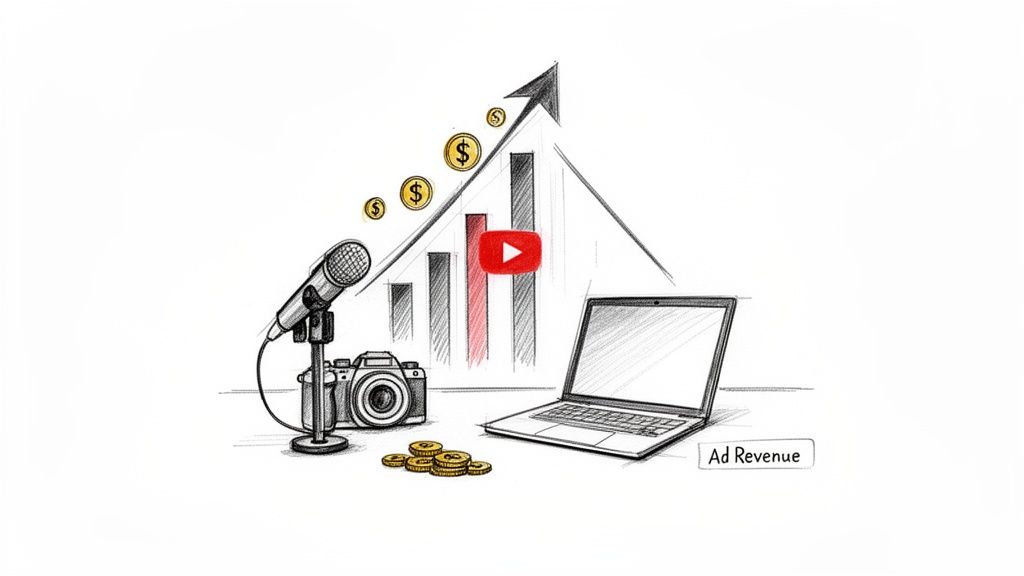
Your content acts as the foundation for attracting an audience. On YouTube, you can earn from ads shown before or during your videos once you meet the YouTube Partner Program requirements. Similarly, blogs can display ads through networks like Google AdSense or Mediavine, and podcasts can include sponsored messages or host-read ads.
The income potential grows as your content library and audience expand. A single viral video or blog post can continue earning ad revenue long after its publication date. For example, a popular tech review by someone like Marques Brownlee (MKBHD) on YouTube continues to generate income from new viewers discovering it through search months or even years later.
Real-Life Example: Maria started a blog about container gardening for apartment dwellers. She consistently published one detailed, helpful article per week. For the first year, she earned almost nothing. In her second year, after reaching a critical mass of traffic, she was accepted into the Mediavine ad network. Now, her library of 100+ articles generates over $3,000 per month in passive ad revenue, as old and new posts continue to attract readers from Google search.
Getting Started with Content Creation
- Choose Your Platform and Niche: Start with one platform you enjoy creating for, like YouTube, a blog (using WordPress), or a podcast (using Spotify for Podcasters). Select a specific niche you are passionate and knowledgeable about, such as vintage camera restoration or sustainable gardening.
- Create and Publish Consistently:
- Establish a Schedule: Aim for a consistent schedule, such as one new video or blog post per week, to build momentum and audience expectations.
- Focus on Quality: Prioritize helpful, entertaining, and well-produced content. Learn basic SEO for your chosen platform to help people discover your work. For example, use relevant keywords in YouTube titles and descriptions.
- Monetize and Diversify: Once you build an audience, apply for monetization programs like the YouTube Partner Program or Google AdSense. Don't rely solely on ads; explore affiliate marketing, sponsorships, and selling your own digital products to create multiple income streams from the same content.
Key Insight: Consistency trumps perfection. Many aspiring creators fail because they wait for the perfect idea or equipment. The key is to start creating, learn from audience feedback, and improve over time. Your first 100 pieces of content are your practice; the real growth often comes after that.
6. Affiliate Marketing
Affiliate marketing allows you to earn income by promoting another company's products or services. You share a unique affiliate link, and when someone makes a purchase through that link, you earn a commission. This model transforms your content, audience, or platform into a revenue-generating asset without needing to create a product.
This approach lets you monetize your influence and expertise in a specific niche. You get paid for connecting your audience with products you genuinely believe in, making it one of the most accessible passive income ideas for content creators.
How Affiliate Marketing Works
When you join an affiliate program like Amazon Associates or ShareASale, you receive a unique, trackable link for a product. You then place this link in your content, such as a blog post, YouTube video description, or social media bio. If a reader clicks your link and buys the product, the company’s affiliate software tracks the sale back to you, and you receive a percentage of the sale as a commission.
For example, a tech blogger might review a new laptop and include an affiliate link. If a reader buys the $1,500 laptop through that link and the commission is 4%, the blogger earns $60. Once the content is published, it can generate these commissions passively for months or even years.
Real-Life Example: Tom runs a YouTube channel focused on home coffee brewing. In his video "The Best Espresso Machines Under $500," he reviews five different models and includes Amazon affiliate links for each in the description. The video, published over a year ago, still gets thousands of views a month from people searching for recommendations. It passively earns him between $400 and $700 per month in commissions as viewers make purchases based on his trusted advice.
Getting Started with Affiliate Marketing
- Choose a Niche and Platform: Focus on a topic you are passionate about, like luxury watches or productivity software. Build your platform, whether it's a blog, YouTube channel, or a targeted email list.
- Find Affiliate Programs:
- Affiliate Networks: Platforms like ShareASale or CJ Affiliate provide access to thousands of merchant programs in various industries.
- Direct Programs: Many companies, especially in the software space, run their own high-commission programs. Amazon Associates is a popular starting point for physical products.
- Create Valuable Content: Don't just push links. Create helpful content like in-depth reviews, comparison articles, or tutorials that solve a problem for your audience. For example, a detailed "best of" listicle with your affiliate links can perform exceptionally well.
Key Insight: Authenticity is your greatest asset. Only promote products you genuinely use and would recommend to a friend. Your audience's trust is difficult to earn and easy to lose, and transparent, honest recommendations will always generate better long-term results than chasing high-commission offers for subpar products.
7. Peer-to-Peer Lending & Crowdfunding
Peer-to-peer (P2P) lending allows you to act like a bank, lending money directly to individuals or small businesses through online platforms and earning interest on the repayments. This model cuts out traditional financial institutions, often resulting in higher returns for investors compared to savings accounts. It’s one of the best passive income ideas for those comfortable with a bit more risk for potentially higher rewards.
This approach transforms your capital into a loan portfolio that generates a steady stream of interest income. You get paid for providing capital to borrowers who might be consolidating debt or starting a business.
How Peer-to-Peer Lending Works
When an individual applies for a loan on a platform like Prosper or LendingClub, the platform assesses their credit risk and assigns an interest rate. As an investor, you can then choose to fund a small portion of that loan, perhaps just $25. By funding dozens or even hundreds of these small loan pieces, you diversify your investment and mitigate the impact of any single borrower defaulting.
The real strength of P2P lending is creating a diversified portfolio of loans. As borrowers make their monthly payments, you receive a portion of the principal and interest, which you can then withdraw or reinvest into new loans to compound your earnings.
Real-Life Example: Michael wanted to generate better returns on $5,000 of his savings. He opened an account with Fundrise, a real estate crowdfunding platform. Instead of buying a single property, his investment was spread across a diversified portfolio of dozens of commercial and residential real estate projects (an eREIT). He set his dividends to automatically reinvest. He now receives quarterly dividend payments and benefits from property appreciation without ever having to deal with tenants or property management.
Getting Started with Peer-to-Peer Lending
- Choose a Platform: Sign up for an account on a reputable P2P lending site like Prosper or a real estate crowdfunding platform like Fundrise.
- Fund Your Account & Diversify:
- P2P Loans: Start with a minimum investment and spread it across at least 50 to 100 different loans to minimize default risk. Focus initially on borrowers with higher credit grades (lower risk).
- Real Estate Crowdfunding: Platforms like Fundrise allow you to invest in a diversified portfolio of real estate projects (an eREIT) with a relatively small initial investment.
- Automate Your Strategy: Use the platform's automated investing tools. You can set criteria for the types of loans you want to fund (e.g., credit score, loan purpose), and the system will automatically invest your available cash, keeping your money working for you.
Key Insight: Success in P2P lending hinges on diversification. A single default can hurt, but spreading your investment across hundreds of notes makes the impact negligible. Treat it like building a bond portfolio, focusing on managing risk across a wide base of borrowers rather than picking individual "winners."
8. Automated E-Commerce & Print-on-Demand
Automated e-commerce using print-on-demand (POD) services is a powerful way to generate passive income with minimal upfront investment. This business model involves creating custom designs for products like t-shirts, mugs, or posters, and selling them through an online storefront. The POD service handles all manufacturing, packaging, and shipping, but only after a customer places an order.
This approach removes the biggest hurdles of traditional e-commerce: you don't need to buy inventory, manage a warehouse, or handle logistics. Your main role is to create appealing designs and market your store, making it one of the best passive income ideas for creative individuals.
How Print-on-Demand Works
When a customer buys a product from your online store, the order is automatically sent to your POD partner, such as Printful or Printify. They print your design onto the product, pack it, and ship it directly to the customer under your brand. You pay the POD company their base price for the product and shipping, and you keep the profit.
For example, if you sell a t-shirt for $30 and the POD provider’s cost is $15, you make a $15 profit on each sale. Once the store is set up and designs are uploaded, the order fulfillment process is almost entirely hands-off.
Real-Life Example: An art student named Chloe loved creating minimalist line drawings of dog breeds. She opened an Etsy shop integrated with Printful. She uploaded her designs for popular breeds like Golden Retrievers and French Bulldogs onto various products—t-shirts, mugs, and tote bags. By using Etsy's targeted keywords (e.g., "Golden Retriever Mom Gift"), her products began showing up in searches. Her store now makes a few dozen sales a week, earning her over $500 a month passively while she focuses on her studies.
Getting Started with Print-on-Demand
- Choose a Niche and Platform: Decide on a target audience, like cat lovers or vintage car enthusiasts. Then, set up a storefront using a platform like Shopify, Etsy, or directly on POD marketplaces like Redbubble.
- Create Your Designs:
- Design Tools: Use software like Canva for simple text-based designs or Adobe Illustrator for more complex graphics. You can also hire freelance designers on platforms like Fiverr.
- Research Trends: Look for popular niches and design styles on sites like Etsy, Pinterest, or Google Trends to see what's currently selling well.
- Integrate and Automate: Connect your chosen e-commerce platform with a POD service like Printful or Printify. Upload your designs to their product mockups, set your prices, and publish them to your store. Your primary ongoing task will be marketing your products through social media or ads.
Key Insight: Success in print-on-demand isn't just about great designs; it's about targeting a passionate niche. A generic "funny t-shirt" store will struggle, but a store dedicated to "funny shirts for accountants" can build a loyal following and generate consistent, passive sales.
9. License Your Creations (Photos, Music, Designs)
If you have a creative talent, licensing your original content is a powerful way to generate passive income. This involves creating digital assets like photos, music tracks, or graphic designs once and then selling the rights to use them to multiple customers through online marketplaces. Each download or license generates a royalty payment for you. This makes it one of the best passive income ideas for artists and creators.
This approach transforms a creative hobby or skill into a recurring revenue stream. You do the creative work upfront, and a single well-crafted asset can earn money for years with no additional effort.
How Licensing Your Creations Works
When you upload your work to a platform like Shutterstock or AudioJungle, you grant the platform the right to license it to its customers. A blogger might buy a license for one of your photos for an article, or a YouTuber might license your music track for a video. You receive a percentage of the sale price each time someone uses your work.
The key to success is volume and demand. A single photo might only earn cents per download, but a portfolio of thousands of high-quality, in-demand images can generate a substantial monthly income. Similarly, a hit music track on a platform like AudioJungle could be licensed thousands of times.
Real-Life Example: As a hobbyist photographer, James uploaded his portfolio of over 500 high-quality travel and business-themed photos to Adobe Stock and Shutterstock. He focused on in-demand keywords like "remote work," "team collaboration," and "sustainable travel." Initially, he only made a few dollars a month. But as his portfolio grew and his images gained traction, his earnings compounded. He now makes a consistent $300 a month from photos he took years ago, with zero ongoing work.
Getting Started with Licensing
- Identify Your Niche and Platform: Determine your strongest creative skill. Are you a photographer, musician, or graphic designer? Choose platforms that specialize in your asset type.
- Create and Upload Your Content:
- Photographers: Websites like Shutterstock and Getty Images are industry standards for stock photography.
- Musicians: Platforms like AudioJungle or Epidemic Sound are excellent for licensing royalty-free music and sound effects.
- Designers: Marketplaces like Creative Fabrica or Etsy (for digital downloads) cater to graphic designers selling fonts, templates, and illustrations.
- Optimize for Discovery: Research what's currently in demand. Use relevant keywords, tags, and descriptive titles to help buyers find your work. Uploading content in batches and maintaining a consistent style can also help you build a following and increase sales.
Key Insight: Don't just create what you enjoy; create what the market needs. Research trending topics, styles, and keywords within your niche. High-demand content, such as business-themed stock photos or upbeat corporate music, often sells more consistently than highly artistic but niche creations.
10. Automated Dropshipping & E-Commerce Stores
Automated dropshipping creates a hands-off e-commerce business, making it one of the most popular passive income ideas for entrepreneurs. It involves setting up an online store where you list products, but a third-party supplier handles all inventory, packing, and shipping directly to the customer. Once set up and optimized, the store can generate sales with minimal daily intervention.
This model lets you run a retail business without the massive upfront cost of buying inventory or the logistical headache of order fulfillment. Your primary role shifts to marketing, customer service, and product curation, much of which can be automated.
How Automated Dropshipping Works
You act as the storefront or middleman. A customer places an order on your Shopify store, you collect the payment, and then you purchase the item from your supplier (like one on AliExpress) for a lower price. The supplier ships the product directly to the customer, and you keep the profit margin.
The "passive" component comes from using apps and software to automate this process. Tools like Oberlo or AutoDS can automatically forward customer orders to your supplier, track shipping updates, and even manage pricing, turning a complex process into a few clicks.
Getting Started with Automated Dropshipping
- Build Your Storefront: Create an e-commerce store using a platform like Shopify, which is known for its user-friendliness and vast app ecosystem.
- Find Your Niche and Products:
- Source from Suppliers: Use platforms like AliExpress, Spocket, or CJdropshipping to find products.
- Focus Your Catalog: Start small. Instead of listing hundreds of items, focus on 3-5 "winning products" identified through trend research on TikTok or Facebook.
- Automate and Market:
- Install Automation Apps: Integrate apps like AutoDS to handle order fulfillment and inventory syncing.
- Run Targeted Ads: Use Facebook or TikTok ads to drive traffic. Start with a small daily budget to test product viability before scaling your ad spend.
Key Insight: Success in dropshipping isn't about finding cheap products; it's about building a strong brand and providing excellent customer service. Since you don't control shipping, a responsive support system is crucial for managing customer expectations and differentiating your store from competitors.
Top 10 Passive Income Ideas — Quick Comparison
This table provides a side-by-side comparison to help you quickly evaluate which passive income ideas best align with your resources, timeline, and goals.
| Strategy | Upfront Investment | Passive Potential (1-10) | Time to First $1 | Risk Level | Best For… |
|---|---|---|---|---|---|
| Dividend Investing | High Capital, Low Time | 9 | 3-6 Months | Low-Medium | Long-term investors with capital. |
| Rental Properties | Very High Capital, Medium Time | 8 | 1-3 Months | Medium | Those with significant capital and a long-term outlook. |
| High-Yield Savings | Low-High Capital, Very Low Time | 10 | < 1 Month | Very Low | Anyone seeking safe, guaranteed returns (e.g., for an emergency fund). |
| Digital Products | Low Capital, High Time | 9 | 3-6 Months | Low | Experts and creators who can package their knowledge. |
| Content Creation | Very Low Capital, Very High Time | 7 | 6-18 Months | Low | Passionate individuals with patience and consistency. |
| Affiliate Marketing | Low Capital, High Time | 8 | 3-9 Months | Low | Content creators and niche experts with an existing audience. |
| P2P Lending | Medium Capital, Low Time | 7 | 1-3 Months | Medium-High | Investors comfortable with higher risk for higher yields. |
| Print-on-Demand | Very Low Capital, Medium Time | 6 | 1-4 Months | Very Low | Creative individuals and designers. |
| Licensing Creations | Low Capital, Medium Time | 8 | 2-6 Months | Low | Photographers, musicians, and graphic designers. |
| Dropshipping | Low-Medium Capital, Medium Time | 5 | 1-3 Months | High | Marketers and entrepreneurs willing to manage ads and customer service. |
Final Thoughts
The journey to financial independence is paved not with a single golden ticket but with a series of strategic, well-laid stones. Throughout this guide, we've explored ten of the best passive income ideas, each offering a unique pathway toward generating revenue with diminishing active effort over time. From the tangible world of real estate and dividend stocks to the digital frontier of online courses, affiliate marketing, and automated e-commerce, the opportunities are as diverse as the individuals seeking them. The common thread is clear: true passive income is born from significant upfront investment, whether that’s capital, time, or creative energy.
Synthesizing Your Strategy: From Idea to Action
We've delved into the specifics of each stream, analyzing startup costs, risk levels, potential returns, and step-by-step implementation. You've seen that while a high-yield savings account offers low-risk stability, creating and licensing digital products demands a high initial time investment but offers incredible scalability. Similarly, building a portfolio of dividend-paying stocks requires financial capital and research, whereas a successful blog leverages creative capital and consistency to generate affiliate and ad revenue.
The core takeaway is that there is no universal "best" passive income stream; there is only the best fit for your unique circumstances. Your ideal path depends on a careful assessment of three key personal assets:
- Financial Capital: How much money can you realistically invest? Ideas like rental properties and significant stock market positions demand more upfront capital.
- Time Capital: How many hours can you dedicate initially? Building a YouTube channel, a blog, or an online course requires a substantial time commitment before it becomes passive.
- Skill Capital: What are you good at? Your expertise as a photographer, writer, designer, or marketer can be directly monetized through licensing, digital products, or affiliate content.
The Power of Diversification and Long-Term Vision
A crucial concept to embrace is the power of synergy and diversification. The most successful wealth-builders rarely rely on a single income source. Instead, they create a resilient financial ecosystem where multiple streams work in concert. Imagine a scenario where the cash flow from your rental property is used to systematically invest in a diversified portfolio of index funds and dividend stocks. As that portfolio grows, the dividends it generates could fund the startup costs for your next venture, like an automated print-on-demand store.
This interconnected approach mitigates risk. If one income stream falters, others can provide a buffer. More importantly, it accelerates wealth creation through the power of compounding. This isn't a get-rich-quick scheme; it's a strategic, long-term plan for building a financial future that gives you freedom, flexibility, and control over your time.
Your next step is not to try everything at once. It is to choose one or two ideas from this list that resonate most deeply with your current resources and long-term goals. Commit to the initial work, track your progress, and learn from the process. The path to passive income is a marathon, not a sprint, and the most important step is the one you take today. By starting small, staying consistent, and continually reinvesting in your knowledge and assets, you can transform the concept of earning while you sleep from a distant dream into a tangible reality.
Ready to take a deeper dive into personalized wealth strategies and get expert insights on building your financial future? At Top Wealth Guide, we provide the tools and analysis you need to navigate the world of investing and income generation with confidence. Visit us at Top Wealth Guide to access exclusive resources and accelerate your journey to financial freedom.
Frequently Asked Questions (FAQ)
1. What is a realistic passive income goal for a beginner?
A realistic goal for a beginner in the first year is to generate an extra $100 to $500 per month. This could come from dividend investing, a high-yield savings account, or early sales from a digital product. It's crucial to focus on building the asset first; substantial income often takes 2-3 years of consistent effort or significant capital investment.
2. Which passive income idea requires the least amount of money to start?
Print-on-demand, licensing your creations, and content creation (blogging/YouTube) require the least amount of money. You can start with less than $100 for basic tools, software subscriptions, or a website domain. These methods substitute a high upfront time investment for financial capital.
3. Can passive income be truly 100% passive?
No income stream is ever 100% passive indefinitely. Even the most passive ideas, like dividend investing, require periodic portfolio reviews. Rental properties need management (even if outsourced), and digital products may need occasional updates or customer support. The goal is to create systems that are mostly passive, requiring minimal ongoing maintenance.
4. How are passive income streams taxed?
Taxation varies significantly by income type and your location. Investment income (dividends, capital gains) is often taxed at a lower rate than earned income. Rental income has unique deductions like depreciation. Income from digital products or affiliate marketing is typically taxed as business income. It is essential to consult with a tax professional.
5. What is the biggest mistake people make when pursuing passive income?
The biggest mistake is giving up too soon. Most passive income streams, especially those requiring a time investment like content creation or building a digital product, have a long ramp-up period where you see little to no return. Success requires patience and consistency through this initial phase.
6. Is it better to focus on one passive income stream or build several at once?
For beginners, it is far better to focus on building one income stream to a significant level before diversifying. Trying to start a blog, a YouTube channel, and a dropshipping store simultaneously will likely lead to burnout and failure in all three. Master one, automate it as much as possible, and then use the cash flow and experience to build the next.
7. Which passive income idea has the highest potential return?
Rental properties (due to leverage and appreciation) and creating a successful digital product or online course arguably have the highest potential returns. A single online course can scale to generate tens of thousands of dollars per month. However, these also come with significant upfront work or capital risk.
8. How can I earn passive income if I have no special skills?
Everyone has knowledge or experience that can be monetized. If you don't feel you have a "special skill," start with capital-based ideas like investing in dividend ETFs, REITs, or using P2P lending platforms. These leverage your money rather than a specific creative or technical skill.
9. What is the difference between passive income and a side hustle?
A side hustle is active income; you are trading your time directly for money (e.g., driving for Uber, freelance writing). Passive income comes from an asset you've built or bought that generates money with minimal ongoing effort. The goal is often to turn a successful side hustle into a passive income stream (e.g., turn freelance coaching into an online course).
10. Are high-yield savings accounts a good passive income strategy with inflation?
Yes, especially for your emergency fund or short-term savings. While an HYSA's interest rate may not always beat inflation, it will significantly reduce the loss of purchasing power compared to a standard savings or checking account (which often earns close to 0%). It is a defensive strategy that ensures your safe money is still working for you.
This article is for educational purposes only and is not financial or investment advice. Consult a professional before making financial decisions.
