


Market downturns can be unsettling, but they also present a powerful opportunity for savvy investors. This is where tax-loss harvesting comes in: a strategic approach to selling investments at a loss to reduce your capital gains tax liability. By turning inevitable paper losses into tangible tax savings, you can significantly enhance your portfolio's after-tax returns and potentially lower your overall income tax bill.
This isn't just about selling low; it's a sophisticated technique to make lemonade out of lemons. The core principle is simple: losses on investments held in a taxable brokerage account can be used to offset taxes on gains from other investments. If your losses exceed your gains for the year, you can even use up to $3,000 to offset your regular income, such as your salary. Any remaining losses can be carried forward indefinitely to offset future gains.
This comprehensive guide moves beyond the basics to explore 10 actionable tax loss harvesting strategies, complete with real-world examples, step-by-step implementation tips, and crucial pitfalls to avoid. We'll demystify complex regulations like the wash-sale rule, analyze timing and rebalancing, and detail specific tactics for stocks, ETFs, and even cryptocurrency. Whether you're a seasoned investor or just starting to manage a taxable account, you'll find the insights needed to make tax-loss harvesting a core part of your wealth-building toolkit. Let's dive into how you can make your portfolio more tax-efficient and turn market volatility into a financial advantage.
In This Guide
- 1 1. Wash Sale Rule Management
- 2 2. Cross-Asset Class Harvesting
- 3 3. Opportunistic Loss Harvesting
- 4 4. Mutual Fund and ETF Substitution
- 5 5. Systematic Year-End Harvesting
- 6 6. Loss Carryforward Strategy
- 7 7. Concentrated Position Harvesting
- 8 8. Dividend-Adjusted Harvesting
- 9 9. Strategic Gain Realization with Harvesting Coordination
- 10 10. Automated/Algorithmic Loss Harvesting
- 11 10-Strategy Tax-Loss Harvesting Comparison
- 12 Integrating Tax-Loss Harvesting Into Your Long-Term Plan
- 13 Frequently Asked Questions (FAQ)
- 13.1 1. What is tax-loss harvesting?
- 13.2 2. What is the wash-sale rule?
- 13.3 3. Can I do tax-loss harvesting in my 401(k) or IRA?
- 13.4 4. What is a "substantially identical" security?
- 13.5 5. How much can tax-loss harvesting save me?
- 13.6 6. What is a capital loss carryforward?
- 13.7 7. When is the best time to tax-loss harvest?
- 13.8 8. Does tax-loss harvesting mean I'm timing the market?
- 13.9 9. Can automated services (robo-advisors) do this for me?
- 13.10 10. Do I need a financial advisor to do tax-loss harvesting?
1. Wash Sale Rule Management
At the core of any effective tax-loss harvesting strategy is a deep understanding and careful management of the wash sale rule. The IRS created this rule to prevent investors from selling a security at a loss and immediately repurchasing it simply to claim a tax deduction without genuinely changing their market position. Failing to navigate this rule can completely invalidate your intended tax benefits.
A wash sale occurs if you sell a security at a loss and, within a 61-day period (30 days before the sale and 30 days after), you buy a "substantially identical" security. This 61-day window is critical. If you trigger this rule, the IRS disallows the capital loss deduction for that tax year. Instead, the disallowed loss is added to the cost basis of the new, replacement security, delaying the tax benefit until you sell the new position.
How to Implement Wash Sale Rule Management
Successfully managing the wash sale rule involves replacing your sold security with a similar, but not "substantially identical," asset. This allows you to maintain your desired market exposure while legally recognizing the capital loss.
Real-Life Example:
Sarah, an investor, holds 100 shares of Coca-Cola (KO) which she bought at $60 per share. The stock drops to $50, creating a $1,000 unrealized loss. She believes in the long-term prospects of the consumer staples sector but wants to capture the tax loss. She sells her 100 shares of KO, realizing the $1,000 loss. To maintain her sector exposure without triggering a wash sale, she immediately buys shares of PepsiCo (PEP), a direct competitor but not a "substantially identical" security. After 31 days, she can sell PEP and repurchase KO if she still prefers it, having successfully harvested the loss.
Actionable Tips:
- Use Tracking Tools: Many brokerage platforms have built-in wash sale tracking features that can alert you to potential violations across your accounts.
- Plan Replacements: Before selling a security, identify a suitable, non-identical replacement to ensure you can reinvest the proceeds immediately.
- Set Calendar Alerts: Mark your calendar for 31 days after the sale date to remind you when the wash sale window closes for that specific transaction.
- Document Everything: Keep meticulous records of all sale and purchase dates and amounts for your tax reporting.
2. Cross-Asset Class Harvesting
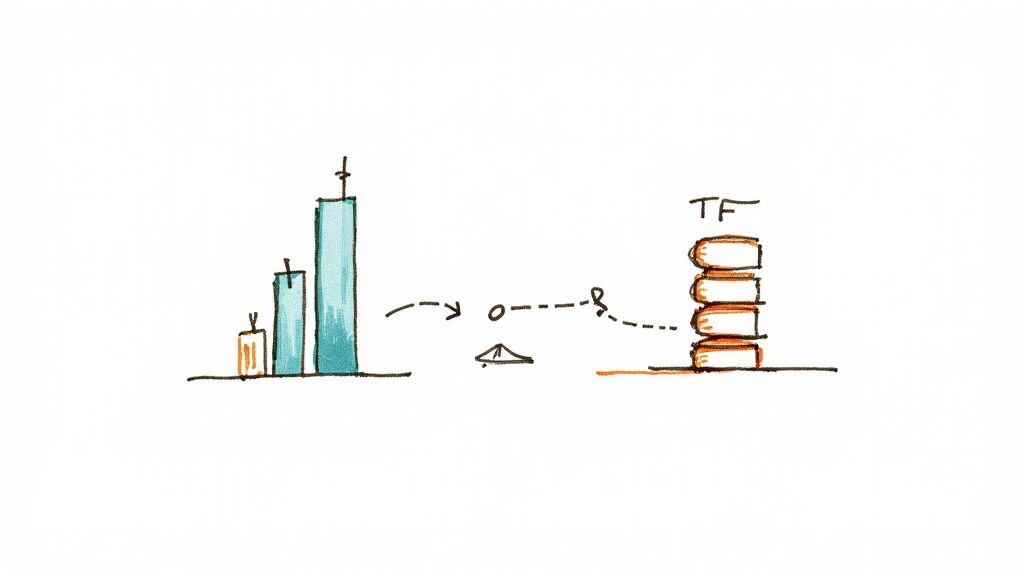
Beyond simple one-for-one swaps, a more sophisticated tax-loss harvesting strategy involves harvesting losses in one asset class while reinvesting in a different, yet correlated, asset class. This technique, known as cross-asset class harvesting, allows you to capture a tax loss while maintaining your desired economic exposure and overall portfolio risk profile. It's an advanced method for investors looking to optimize their tax alpha without significantly deviating from their strategic asset allocation.
This approach hinges on the concept of correlation. By selling a losing position and immediately buying an asset that tends to move in a similar direction, you stay invested in the market's potential upside. The key is that the replacement asset is not "substantially identical," making it a valid maneuver that avoids the wash sale rule while preserving your investment thesis.
How to Implement Cross-Asset Class Harvesting
Successfully using this strategy requires careful asset selection to ensure the replacement holding aligns with your portfolio goals. The goal is to find a substitute that offers similar risk-return characteristics without being a direct replica of the asset you sold. This often involves shifting between different security types, such as from individual securities to funds or vice-versa.
Real-Life Example:
David holds several individual technology stocks (like NVIDIA, AMD, and Broadcom) in his portfolio. During a tech sector downturn, his basket of tech stocks has an unrealized loss of $15,000. He wants to harvest this loss but maintain his exposure to the tech industry's recovery potential. He sells all the individual stocks, realizing the $15,000 loss. He then immediately reinvests the entire proceeds into the Invesco QQQ Trust (QQQ), an ETF that tracks the Nasdaq-100 index, which is heavily weighted in technology. This move allows him to book the tax loss while staying broadly invested in the same economic sector.
Actionable Tips:
- Use Correlation Analysis: Utilize tools from your brokerage or financial software to analyze the historical correlation between the asset you're selling and its potential replacement.
- Monitor Your Basis: Keep a close watch on the cost basis of the new asset, as this will determine your future capital gains or losses when you eventually sell it.
- Compare Expense Ratios: When moving into an ETF or mutual fund, always consider the expense ratio of the substitute security to ensure it doesn't erode your long-term returns.
- Document Your Thesis: Keep a record of why you believe the replacement asset is a suitable but not substantially identical substitute for tax purposes.
- Plan Your Rebalance: This strategy is often temporary. For more information, explore effective portfolio rebalancing strategies to eventually return to your original, preferred holdings after the 31-day wash sale window has passed.
3. Opportunistic Loss Harvesting
While many investors schedule tax-loss harvesting for the end of the year, a more dynamic approach involves harvesting losses reactively as market downturns occur. This strategy, known as opportunistic loss harvesting, allows you to capitalize on market volatility and capture tax benefits whenever they appear, rather than waiting for a specific date on the calendar. By acting during periods of significant price drops, you can lock in losses at their most impactful levels.
This proactive method turns market corrections and sector-specific slumps into valuable tax-saving events. Instead of being a passive observer during a downturn, you become an active participant, improving your portfolio's tax efficiency in real time. The key is to be prepared and act decisively, transforming a negative market event into a positive outcome for your tax bill without fundamentally altering your long-term investment plan. This is one of the more flexible tax loss harvesting strategies available.
How to Implement Opportunistic Loss Harvesting
Successful opportunistic harvesting requires a pre-planned framework for identifying and acting on market dips. This means setting clear triggers and having replacement assets ready, allowing you to execute your strategy based on data and logic rather than emotional reactions to market news.
Real-Life Example:
In early 2022, the technology sector experienced a significant correction. Maria, an investor, saw her position in a growth-focused tech ETF decline by 20%, resulting in an $8,000 unrealized loss. Instead of waiting until December, she acted in February. She sold the tech ETF to capture the $8,000 loss and immediately bought a different, but highly correlated, large-cap growth ETF. By acting opportunistically during the market slump, she locked in a significant tax asset that she could use to offset gains later in the year, long before the typical year-end rush.
Actionable Tips:
- Set Predetermined Triggers: Establish specific decline thresholds (e.g., a 10% or 15% drop from your cost basis) that will automatically trigger a review for harvesting.
- Maintain a 'Harvest-Ready' List: Keep a watchlist of holdings currently at a loss, along with their pre-identified, non-identical replacement securities.
- Act, Don't React: Execute your plan based on your established triggers, not on fear or panic from watching daily market news. A plan prevents emotional decision-making.
- Consider Your Tax Bracket: Evaluate if the loss will be more valuable this year or in a future year where your income might be higher. This is a crucial element of effective tax loss harvesting strategies.
4. Mutual Fund and ETF Substitution
One of the most powerful and widely used tax loss harvesting strategies involves substituting a sold mutual fund or ETF with a highly correlated, but not identical, alternative. This tactic allows an investor to immediately realize a capital loss for tax purposes while maintaining nearly the same market exposure, risk profile, and diversification. It's a cornerstone of modern portfolio management, particularly for those using index-based investments.
The core principle is to sidestep the wash sale rule's "substantially identical" clause. While selling Apple stock and immediately buying it back is a clear violation, selling one S&P 500 ETF and buying another from a different fund provider is generally permissible. These funds track the same index but are distinct legal and financial products, allowing you to harvest the loss without a 30-day waiting period out of the market. This keeps your investment strategy on track without interruption.
How to Implement Mutual Fund and ETF Substitution
This strategy requires careful selection of a replacement fund to ensure your portfolio's objectives are not compromised. The goal is to find a substitute that mirrors the performance and characteristics of the original asset as closely as possible without being identical.
Real-Life Example:
Tom invested $50,000 in the Vanguard Total Stock Market ETF (VTI). After a market correction, his investment is worth $42,000. He wants to harvest the $8,000 loss but remain fully invested in the broad U.S. stock market. He sells his entire position in VTI. On the same day, he uses the $42,000 in proceeds to purchase the iShares CORE S&P Total U.S. Stock Market ETF (ITOT). Both ETFs track the total U.S. stock market and have nearly identical performance and low fees, but because they are managed by different companies and track slightly different underlying indexes, the transaction does not trigger the wash sale rule. Tom has successfully harvested the loss while maintaining his investment strategy.
Actionable Tips:
- Verify High Correlation: Use financial data tools to confirm that the replacement fund has a very high correlation (ideally >0.95) with the fund you sold.
- Compare Expense Ratios: When choosing a substitute, select one with a comparable or lower expense ratio to avoid increasing your long-term investment costs.
- Review Fund Holdings: Briefly check the top holdings and sector breakdowns of both funds to ensure there are no major unexpected differences.
- Monitor for Divergence: While highly correlated, the funds may diverge slightly over time due to differences in index tracking and management. Monitor performance periodically.
5. Systematic Year-End Harvesting
Rather than reacting to market volatility, a systematic year-end harvesting strategy involves a disciplined, calendar-based approach to realizing investment losses. This proactive method focuses on a dedicated period, typically in the fourth quarter, to thoroughly review a portfolio and execute trades specifically to optimize your tax position before the deadline. It transforms tax-loss harvesting from a reactive tactic into a planned annual financial checkpoint.
The core principle is to strategically lock in losses to offset any capital gains realized during the year. By doing this systematically, you ensure you don't miss opportunities while also creating a structured process. This approach helps reduce your current-year tax liability and allows for a more predictable tax planning outcome. Instead of waiting for a market dip, you actively seek out and crystallize losses in November or December, giving you a clear picture of your tax situation heading into the new year.
How to Implement Systematic Year-End Harvesting
Executing this strategy requires planning and foresight, starting well before the last few weeks of December. The goal is to align your loss realization with your gain realization to achieve the most favorable tax result. Learn more about the specific tax planning moves every investor should make before December to prepare effectively.
Real-Life Example:
In October, an investor named Ben reviews his portfolio. He sees that earlier in the year he sold a real estate investment for a $20,000 long-term capital gain. His annual portfolio review reveals an international stock fund with an unrealized loss of $18,000. To minimize his tax bill, he sells the international fund in November, realizing the $18,000 loss. This loss directly offsets most of his gain, leaving him with only $2,000 in taxable capital gains for the year. He then reinvests the proceeds into a different but similar international fund to maintain his asset allocation.
Actionable Tips:
- Start Planning in Q3: Begin reviewing your portfolio for potential losses in September or October to give yourself ample time to strategize.
- Calculate Net Gains/Losses: Tally up all realized gains and losses to date to understand how much loss you need to harvest to offset gains.
- Mind the Deadlines: Remember that the last day for stock transactions to settle for the tax year is typically a few business days before December 31st.
- Coordinate with Rebalancing: Integrate your harvesting activities with your annual portfolio rebalancing plan to execute both tasks efficiently.
6. Loss Carryforward Strategy
One of the most powerful and forward-looking tax loss harvesting strategies involves leveraging capital loss carryforwards. This long-term approach allows you to harvest losses that exceed your current-year capital gains and carry the unused amount forward indefinitely to offset gains in future years. It is particularly valuable for investors who may not have significant gains to offset in a given year but anticipate larger capital gains down the road.
When you harvest losses, they first offset capital gains of the same type (short-term losses against short-term gains, long-term against long-term). Any remaining losses can then offset gains of the other type. If you still have a net capital loss after this, you can deduct up to $3,000 of it against your ordinary income. Any loss beyond that $3,000 limit becomes a carryforward, a valuable asset you can use in subsequent tax years without an expiration date.
How to Implement a Loss Carryforward Strategy
Implementing this strategy is less about a single action and more about a long-term mindset of building a "tax asset." You strategically realize losses whenever prudent, even if you don't have immediate gains to offset, knowing you are creating a reserve to shield future profits from taxes.
Real-Life Example:
In a bear market year, an investor named Chloe has no capital gains but realizes a net capital loss of $50,000 through aggressive harvesting. That year, she uses $3,000 of the loss to reduce her taxable salary income. The remaining $47,000 becomes a capital loss carryforward. Three years later, she sells a successful startup investment, realizing a $100,000 long-term capital gain. Her $47,000 carryforward is automatically applied, reducing her taxable gain to just $53,000 and saving her thousands in capital gains tax.
Actionable Tips:
- Document Meticulously: Keep precise records of your carryforward amounts. The IRS requires you to report this on Schedule D of your tax return each year until the balance is used up.
- Anticipate Future Gains: Align your harvesting with future financial events, such as selling a business, real estate, or a concentrated stock position. Learn more about how to minimize your capital gains tax with strategic planning.
- Consider State Taxes: Be aware that state tax rules for loss carryforwards can differ from federal rules. Check your state's specific regulations.
- Factor into Estate Planning: Capital loss carryforwards are extinguished upon death and cannot be passed on to heirs, so plan to use them during your lifetime.
7. Concentrated Position Harvesting
For investors holding a significant portion of their wealth in a single stock, such as employer stock or an inherited position, concentrated position harvesting is a critical tax loss harvesting strategy. This approach focuses on systematically diversifying out of the oversized position by selling off losing investments elsewhere in the portfolio. The harvested losses create a tax buffer that can offset the capital gains realized from selling shares of the concentrated holding.
This technique allows you to rebalance your portfolio and reduce single-stock risk without facing a massive, immediate tax bill. Instead of realizing a large gain all at once, you strategically pair sales of the appreciated stock with losses from other assets. This gradual, tax-efficient diversification is essential for long-term wealth management and risk reduction, turning a potential tax headache into a strategic advantage.
How to Implement Concentrated Position Harvesting
The goal is to use losses from various holdings to chip away at the concentrated position's capital gains. This requires careful planning, especially for corporate insiders who face trading restrictions. The process involves identifying underperforming assets and timing their sale to coincide with the sale of a small portion of the appreciated stock.
Real-Life Example:
An executive, Lisa, has $1 million in her company's stock, with a cost basis of only $200,000, leaving an $800,000 unrealized gain. She wants to diversify but avoid a massive tax bill. During a market downturn, her diversified portfolio of bond funds has an unrealized loss of $50,000. She sells the bond funds to harvest the $50,000 loss. She then sells $50,000 worth of her company stock (in terms of gains), making the sale tax-neutral. She can repeat this process over several years, using market downturns as opportunities to gradually and tax-efficiently reduce her concentrated position.
Actionable Tips:
- Start Early: Begin the diversification process as soon as possible to avoid being forced to sell during an inopportune time.
- Harvest Uncorrelated Losses: Look for losses in assets that have low correlation to your concentrated stock to maximize diversification benefits.
- Coordinate with Blackout Windows: If you are a corporate insider, all trades must be planned around company-mandated blackout periods.
- Consider a 10b5-1 Plan: Insiders can establish a pre-arranged trading plan to automatically sell shares over time, which provides an affirmative defense against insider trading allegations and automates diversification.
- Evaluate Charitable Options: For highly appreciated shares, donating them directly to a charity can be a powerful alternative, allowing you to avoid capital gains tax entirely while receiving a charitable deduction.
8. Dividend-Adjusted Harvesting
A more nuanced tax-loss harvesting strategy involves timing your trades around dividend and capital gains distributions. Dividend-Adjusted Harvesting is a sophisticated approach that considers the tax implications of income events, ensuring your loss-harvesting efforts aren't unintentionally offset by taxable income from the very assets you're managing. This method adds a layer of precision, optimizing both capital loss generation and income tax management.
The core principle is to avoid harvesting losses right before a stock's ex-dividend date or a mutual fund's distribution date. Selling just before these events can be inefficient. You would capture the loss but miss out on the dividend, which might have its own tax advantages, especially if it's a "qualified" dividend taxed at lower long-term capital gains rates. Properly timing your trades based on these distribution schedules is a key component of advanced tax loss harvesting strategies.
How to Implement Dividend-Adjusted Harvesting
Implementing this strategy requires proactive calendar management and a clear understanding of how dividends are taxed. By coordinating your trades with distribution schedules, you can strategically capture losses without creating unintended tax consequences from income events.
Real-Life Example:
An investor, Mike, plans to sell a mutual fund that is currently at a $5,000 loss. He checks its financial calendar and notices that the fund is scheduled to make a large capital gains distribution in two weeks. If he holds the fund, he will receive this distribution and owe taxes on it. To avoid this, he sells the fund before the ex-distribution date. This allows him to both realize the $5,000 loss and completely avoid the taxable distribution, a double win for tax efficiency.
Actionable Tips:
- Review Ex-Dividend Calendars: Before executing a sale, check the ex-dividend and distribution dates for the specific stock or fund. Many brokerage platforms and financial news sites provide this information.
- Prioritize Qualified Dividends: Understand the holding period requirements for qualified dividends (typically holding the stock for more than 60 days during the 121-day period that begins 60 days before the ex-dividend date). Avoid trades that would disqualify this favorable tax treatment.
- Analyze the Net Tax Impact: Calculate whether the benefit of harvesting a loss outweighs the tax cost of missing a dividend or receiving a distribution.
- Document Timing Decisions: Keep records explaining why you chose specific sale dates, noting the proximity to dividend or distribution events for tax reporting purposes.
9. Strategic Gain Realization with Harvesting Coordination
While tax-loss harvesting traditionally focuses on offsetting gains, an advanced approach involves pairing it with intentional gain realization. This sophisticated strategy coordinates harvesting losses to neutralize the tax impact of realizing gains during years of unusually low income. It allows you to "step-up" the cost basis of appreciated assets tax-free, optimizing your portfolio's long-term tax efficiency, especially around major life events.
The core principle is to align your investment decisions with your multi-year tax forecast. For instance, if you anticipate a low-income year before a significant salary increase or retirement, you can capitalize on the 0% long-term capital gains tax bracket. By selling appreciated assets up to the bracket's limit and simultaneously harvesting an equivalent amount of losses, you can effectively reset your cost basis higher without incurring a tax bill.
How to Implement Strategic Gain and Loss Coordination
This strategy requires forward-looking financial planning and a clear understanding of your marginal tax rates. It's about turning a temporary dip in income into a permanent tax advantage for your portfolio, making it one of the most proactive tax loss harvesting strategies available.
Real-Life Example:
A couple is in a year where one spouse is on sabbatical, dropping their joint income into the 0% long-term capital gains tax bracket. They have a stock position with a $30,000 unrealized gain. They also have an emerging markets ETF with a $30,000 unrealized loss. They sell both positions in the same year. The $30,000 loss perfectly cancels out the $30,000 gain, resulting in zero tax liability. They then immediately repurchase the appreciated stock, which now has a new, higher "stepped-up" cost basis. This reduces the future capital gains tax they will owe when they sell it again years later.
Actionable Tips:
- Model Multi-Year Scenarios: Use tax planning software to project your income and tax brackets for the next several years to identify low-income opportunities.
- Coordinate with Life Events: Plan this strategy around predictable income changes like retirement, sabbaticals, or starting a business.
- Monitor Marginal Rates: Be acutely aware of how each transaction affects your income thresholds for different tax brackets.
- Consult a Professional: Given the complexity, working with a CPA or financial advisor is crucial to execute this strategy correctly. You can learn more about comprehensive capital gains tax strategies on topwealthguide.com to prepare for the conversation.
10. Automated/Algorithmic Loss Harvesting
For investors seeking a hands-off approach, automated tax loss harvesting represents a powerful modern strategy. Delivered through robo-advisors and advanced portfolio management platforms, this method uses sophisticated algorithms to continuously monitor your holdings for opportunities to realize losses. These systems automatically sell declining assets and replace them with suitable alternatives, all while navigating complex tax rules like the wash sale rule.
This technology-driven approach ensures that potential tax savings are captured systematically and efficiently, often identifying opportunities that a manual review might miss. By automating the process, investors can maintain their target asset allocation while optimizing their portfolio for tax efficiency without needing to constantly track market movements or execute trades themselves. This makes it one of the most accessible tax loss harvesting strategies for busy individuals.
How to Implement Automated/Algorithmic Loss Harvesting
Implementing this strategy involves selecting a robo-advisor or investment platform that offers automated tax-loss harvesting as a feature. Once you fund your account and set your risk tolerance, the platform's algorithms take over the day-to-day management and harvesting decisions. For more insight, you can explore detailed information on algorithmic trading strategies.
Real-Life Example:
An investor named Jessica uses a robo-advisor for her taxable investment account. The platform's algorithm constantly scans her portfolio of ETFs. When a bond ETF she holds drops below a certain threshold due to rising interest rates, the system automatically sells it to realize a loss. Simultaneously, it purchases a different bond ETF with a similar risk profile to keep her asset allocation intact and avoid the wash sale rule. Jessica doesn't have to do anything; the platform's technology handles the entire process, and she receives a tax summary at the end of the year detailing the losses harvested.
Actionable Tips:
- Understand the Algorithm: Inquire about the platform's specific harvesting methodology, such as the loss threshold that triggers a sale and how frequently it scans for opportunities.
- Review Platform Fees: Ensure the tax savings generated by the service outweigh any additional management fees associated with the automated feature.
- Monitor Substitutions: Periodically check your transaction history to understand the replacement assets the algorithm is choosing to ensure they align with your investment goals.
- Check Wash Sale Protections: Confirm how the platform handles wash sales across multiple accounts if you hold other investments with the same institution.
- Review Annual Reports: Use the platform's year-end tax reports to understand the total net losses harvested and provide this information to your tax professional.
10-Strategy Tax-Loss Harvesting Comparison
| Strategy | Complexity | Best For | Key Advantage | Potential Pitfall |
|---|---|---|---|---|
| Wash Sale Rule Management | Low | All Investors | Foundation of all harvesting | Invalidates losses if done incorrectly |
| Cross-Asset Class Harvesting | Medium | Strategic Investors | Maintains broad economic exposure | Risk of correlation mismatch ("tracking error") |
| Opportunistic Loss Harvesting | Medium | Active Investors | Maximizes losses during volatility | Requires constant monitoring & discipline |
| Fund/ETF Substitution | Low | Passive/Index Investors | Simple, effective, low-cost | Must find a suitable, low-cost replacement |
| Systematic Year-End | Low | Planners & Organizers | Predictable annual process | May miss better opportunities mid-year |
| Loss Carryforward | Low | Long-Term Investors | Builds a multi-year "tax asset" | Benefit is deferred, not immediate |
| Concentrated Position | High | Execs, Inheritors | Tax-efficiently reduces single-stock risk | Complex; often requires professional help |
| Dividend-Adjusted | Medium | Dividend Investors | Avoids unwanted taxable income | Benefits are marginal for non-dividend stocks |
| Strategic Gain Realization | High | High-Net-Worth/Planners | Permanently steps-up cost basis tax-free | Requires multi-year income forecasting |
| Automated/Algorithmic | Low | Hands-Off Investors | Effortless, continuous optimization | Subject to platform fees & algorithm limits |
Integrating Tax-Loss Harvesting Into Your Long-Term Plan
Tax-loss harvesting is far more than a simple year-end accounting trick; it is a dynamic, powerful discipline for enhancing your long-term, after-tax investment returns. Throughout this guide, we have moved beyond the basic definition to explore a suite of sophisticated tax loss harvesting strategies. These tactics transform market downturns from portfolio liabilities into valuable tax assets that can be deployed for years to come. By proactively managing one of the few variables you can truly control in investing-your tax liability-you are taking a significant step toward more efficient wealth compounding.
The journey from novice to expert in this domain involves shifting your perspective. Instead of viewing market volatility as a threat, you can begin to see it as an opportunity. A dip in a specific stock, ETF, or even a crypto asset no longer just represents a paper loss; it becomes a potential tax deduction that can offset gains elsewhere in your portfolio or even reduce your ordinary income.
Key Takeaways and Your Path Forward
As we’ve detailed, the strategies at your disposal are varied and scalable to your needs. Let's distill the core principles we've covered into actionable takeaways:
- Master the Rules: The Wash Sale Rule is the foundational boundary. Understanding its 61-day window and how it applies across substantially identical securities is non-negotiable for effective harvesting.
- Think Beyond a Single Asset: Sophisticated investors look across their entire portfolio, employing tactics like cross-asset class harvesting to find opportunities and using ETF or mutual fund substitutions to maintain market exposure while booking a loss.
- Timing is Everything: While year-end harvesting is common, opportunistic harvesting throughout the year can capture temporary dips. For those with substantial unrealized losses, the loss carryforward strategy turns a single year's market pain into a multi-year tax advantage.
- Automation as an Ally: For many investors, the complexity and vigilance required for manual harvesting can be overwhelming. Automated and algorithmic services offer a practical solution, executing these strategies with precision and consistency that is difficult to replicate manually.
The ultimate goal is not just to harvest losses for the sake of it, but to integrate this practice seamlessly into your broader financial plan. It should work in concert with your rebalancing schedule, your strategy for managing concentrated positions, and your plan for realizing long-term capital gains. When coordinated properly, tax-loss harvesting becomes a powerful engine for improving your portfolio’s overall tax efficiency.
Turning Knowledge into Action
Your next step is to move from theory to practice. Begin by reviewing your taxable investment accounts with a clear objective: identify your unrealized gains and losses. This initial analysis is the bedrock of any successful harvesting plan.
Once you have a clear picture, consider which of the strategies we've discussed aligns with your situation. Are you holding a position with a significant loss that could be sold and replaced with a similar, but not "substantially identical," asset? Do you have short-term capital gains from another investment that could be completely offset? By asking these questions, you begin to build a personalized action plan.
For those with complex portfolios, significant capital gains, or concentrated stock positions, consulting a qualified tax professional or financial advisor is a crucial step. They can provide personalized guidance that ensures you remain compliant with all tax laws while maximizing the benefits of these advanced strategies. With a thoughtful plan, you can transform tax-loss harvesting from an annual chore into a consistent contributor to your long-term wealth-building journey.
Frequently Asked Questions (FAQ)
1. What is tax-loss harvesting?
Tax-loss harvesting is the practice of selling an investment at a loss to offset capital gains taxes from other investments. By realizing the loss, you can reduce your tax liability. If your total losses exceed your gains, you can use up to $3,000 per year to offset ordinary income.
2. What is the wash-sale rule?
The wash-sale rule is an IRS regulation that prevents investors from claiming a capital loss on a security if they buy a "substantially identical" security within 30 days before or after the sale (a 61-day window). Violating this rule disallows the tax deduction for the loss.
3. Can I do tax-loss harvesting in my 401(k) or IRA?
No, tax-loss harvesting is only applicable to taxable brokerage accounts. Retirement accounts like 401(k)s and IRAs are tax-deferred or tax-exempt, so realizing gains or losses within them has no immediate tax consequence.
4. What is a "substantially identical" security?
The IRS does not provide a rigid definition, but it generally includes the same company's stock, options on that stock, or bonds from the same issuer with similar terms. ETFs from different providers that track the same index (e.g., VOO and IVV for the S&P 500) are generally not considered substantially identical.
5. How much can tax-loss harvesting save me?
The savings depend on your capital gains and your tax bracket. A harvested loss can offset a short-term capital gain (taxed at ordinary income rates) or a long-term gain (taxed at 0%, 15%, or 20%). At a minimum, it can save you the tax on up to $3,000 of ordinary income.
6. What is a capital loss carryforward?
If your net capital losses in a year exceed $3,000 (after offsetting all gains), the remaining amount is not lost. It can be "carried forward" to future tax years indefinitely to offset future capital gains and up to $3,000 of ordinary income per year.
7. When is the best time to tax-loss harvest?
While many people do it at the end of the year, the best time is whenever a significant loss occurs (opportunistic harvesting). Market downturns at any point in the year can present valuable opportunities.
8. Does tax-loss harvesting mean I'm timing the market?
Not necessarily. Effective tax-loss harvesting involves selling a losing asset and immediately buying a similar (but not identical) replacement. This allows you to realize a tax loss while remaining fully invested and maintaining your desired market exposure, which is different from trying to sell high and buy low.
9. Can automated services (robo-advisors) do this for me?
Yes, many robo-advisors and digital investment platforms offer automated tax-loss harvesting as a key feature. Their algorithms continuously monitor your portfolio and execute trades to harvest losses efficiently without any manual intervention from you.
10. Do I need a financial advisor to do tax-loss harvesting?
While you can do it yourself, especially with simple ETF substitutions, a financial advisor or CPA can be extremely valuable for complex situations, such as managing concentrated stock positions, coordinating with other financial goals, or implementing advanced multi-year tax strategies.
Ready to take your investment strategy to the next level with tools designed for savvy investors? Top Wealth Guide provides in-depth analysis, guides, and resources to help you master concepts like tax-loss harvesting and build a more efficient portfolio. Visit Top Wealth Guide to access exclusive content and empower your financial future.
This article is for educational purposes only and is not financial or investment advice. Consult a professional before making financial decisions.
